Showing posts with label 18th Century. Show all posts

Saturday, March 24, 2018

Project Roundup: What Have I been Doing?

...not much, to be honest.  I have only completed a couple of project, and my major projects have been having...issues.  Two of the major projects from last year--the Hasting's Suit, and the Patchwork Paletot--have both been shelved until further notice.


My other major projects have been having issues getting past the drafting stage--a 1760s Redingote was on deck (I even have the fabrics for it) but I never got around to cutting out a mockup to check the fit, and now it's getting warm enough that it would be next winter before I get to wear it.  The pluderhose for a slightly secret project--I am trying to keep the details a surprise, but not that I am working on German Ren again--have been...problematic.  I found issues with my drafting system not creating a pair of the undershorts which will fit, and went through a full 6 drafts before I got close to having mobility. 
Because it's a good, generic sewing photo.

Monday, January 9, 2017

Aaand I present the 1750s Banyan Documentation. ...Finally.

This has been coming for a while, but I needed to finish (...or write, period) the third post on making the blasted  thing.  But here it is...the documentation for my 1760s banyan, which I shoehorned into the HSM Red challenge (yes, the garment is blue...but there is apparently enough red on it to count).
 

Monday, December 12, 2016

Continuing on: Putting the Banyan together

I suppose I should go over how the 1760s banyan goes together, shouldn't I?  All in all, it's fairly straightforwarded...however, I found that there are a couple of counter-intuitive details in sewing the lining into place.  I based the order of construction, and these little details on an excellent thesis on 18th century Waistcoats (in bibliography), which I figured are closer in construction that a full coat (assuming there are major differences).  Other details are from discussing an extant frock coat with someone who had it to hand.

Thursday, October 20, 2016

A Robe for Reading: 1760s Banyan. I suppose I need sleeves, don't I?

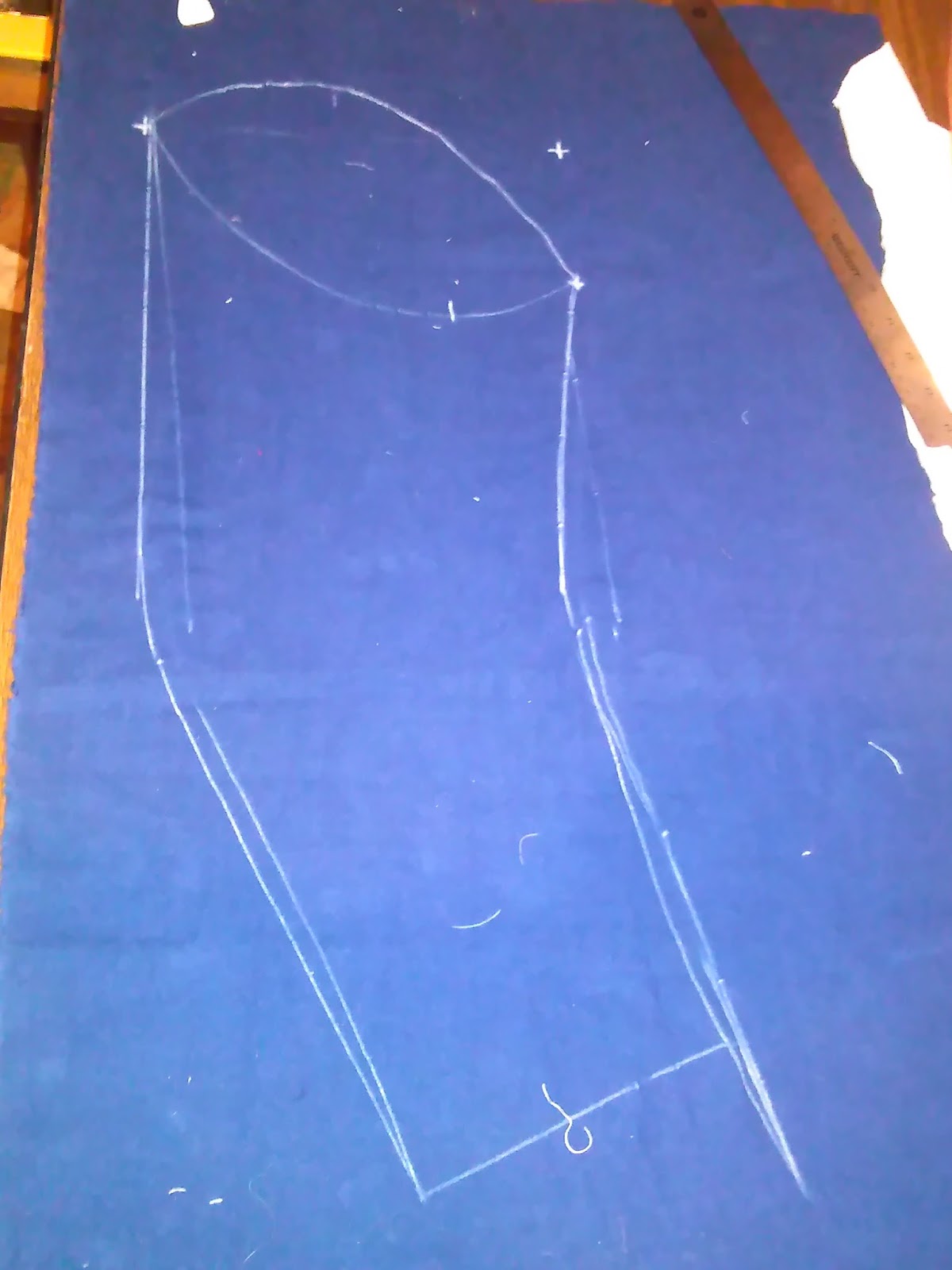
And it's time for Part Two of Three on the making of my Banyan, based on an example from the 1760s in the Los Angeles County Museum of Art.  As you might guess by the title, the majority of this post is on drafting the sleeves--the cuffs and collar are both quite simple.

For a recap, this particular garment is based on the one the LACMA provided a lovely pattern and information on.  However, while they provided a pattern, they do not tell you how to draft the garment so it fits you (their scaling grid is also terrible).

The way I do sleeves is fairly simple; essentially you take the measurements of the armscye, and transfer those to your sleevehead.  However, a word of warning that some parts of sleeve drafting--the hang of the arm in particular--are rather complicated, and something you will have to learn on your own (until I get good enough that I can explain it); when it comes to the lateral rotation (as swinging your arms normally) you want the top and bottom of the sleevehead to be in line with the natural hang of your arm.  As such, it may not hurt to mark the low point while the body is on your victim as well.

Monday, September 26, 2016

A Robe for Reading: Drafting Mid 18th Century Banyan, Part I

For some time now, I have been planning to make a banyan from a grosgrain brocade woven of dead dinosaur (i.e. synthetics, if you aren't familiar with the euphemism) I have had in my stash for years.  Not the loose, kimono style of banyan, but the variety more closely related to the contemporary frock coat.  I love those things.

http://www.lacma.org/patternproject

Tuesday, August 9, 2016

Featured Garments: William Wollaston, 1759

The last two featured garments featured hunters--from the same decade, but different cultures and classes; so, this week we'll take it up a few notches by moving up a class and a century.  Thankfully, there should be less guesswork this time around, since the painting is both clearer, and I have more data to pull from.

The topic for this week is a lovely, blue and white suit worn by one William Wollaston, in a painting by Thomas Gainsborough in 1759--can't get that much different from 1640s German working class.  Or can you...?  Commonly, this is close to a style beginning to appear at this time--the ditto suit, where coat, waistcoat, and breeches were in the same fabric.  Obviously, it isn't, since the coat is white, however....

Oil painting of William Wollaston, 1759, by Thomas Gainsboroug. Holbourne Museum.

Tuesday, January 26, 2016

Fabric Covered Buttons, a la Georgian

UPDATED 3-27-17 with photos using the correct materials.

In the Georgian period (which encompasses Regency), you often see fancy embroidered buttons on various garments--justaucorps, waistcoats, and breeches.  For those of us who prefer plainer garment, there are also plenty of examples of plain ones--especially towards the end of the 18th century and beginning of the 19th.  Obviously, these are embroidered on cloth...but how do you take the cloth and turn it into a flat button without visible stitches?  It's really not difficult, and how else are you going to have buttons covered in the same silk as your coat or waistcoat.

Mariner's Cuff on a Coat.  1785-1790

Sunday, November 29, 2015

Featured Garment: 1765 Skinnrock

In this issue of my Featured Garment, we will be examining a fascinating garment--a military skinnrock (which translates as leather coat) from 1765.


Av brunt läder med gul krage och rabatt med vita "knapphål" av redgarn. Fickorna är fasonerade med stående "knapphål" Gula uppslag. Över klocksprundet bak ett vitt redgarnsband.

En jämförelse med Jacob Gillbergs uniformsritningar av uniform m/1765 visar att den har samma dekorerade bröstrevärer och knapphål som Livgardet till fots rockar. Detta bör då vara en rock m/1765 för Livgardet till fot, men utförd i skinn istället för kläde. Möjligtvis rör det sig om någon form av rock för vakttjänst. 2010-05-17 MM.