Showing posts with label Pants. Show all posts

Saturday, July 22, 2023

A Procrastinated Pair of Round Hose

    Some years ago, in the Pre-Covid times, I decided I wanted to make a plain suit of Elizabethans.  Something from the very end of Elizabeth's reign, and suitable for working in; setting up tents, fighting, maybe some hiking, sitting in the tavern, etc.  A suit of late period clothing where getting it dirty would only add to the character of the garments rather than spoiling them.  In the end, I settled on a suit of round hose in wool broadcloth, and a doublet in another broadcloth or hemp/linen canvas.  While the doublet is still in the works (but is actually being worked on!), I actually finished the round hose over a year ago; I just haven't had any motivation to write (acquiring a new, functional computer helped a bit, but that was purchased *mumble* months ago...).  Wish me luck on this...I'm well out of practice on writing at all, never mind project documentation; thankfully, I took a fair amount of notes...but not enough.

    The hose are, as said, made in common man's cloths and suitable for the tail end of the 1500s and into the 1600s..  Finding exemplars was more difficult than the norm for this period, as working class people aren't particularly popular subjects of paintings, and I additionally had a particular look in my head.  In the end, the Samuel Pepys's Cries of London was a major resource and inspiration for both the hose and doublet forms.

    The Cries of London is a particular genre of artwork which often dealt with the lower classes of various cities (e.g London, Bologna).  The term allegedly comes from the "Cries" or calls of the various traders as they tried to attract customers [Payne, abstract].  In the case of the examples collected by Samuel Pepys, the collection we know as gathered up to 100 years after publishing.  The actual artist of these is unknown, as is the original date, although based on fashion style I estimate this example is from last quarter of the 16th century.

From Spitalfields Life Blog

Tuesday, April 3, 2018

Bad Penny Pluderhose: Drafting the Foundation Shorts (Again)

A couple of years ago, I made my last pair of pluderhose and wrote up a tutorial on drafting them throughout the various stages.  When I revisited them with the plan to make another pair this year, I found that my most excellent instructions...didn't work.  Partly because I didn't take one of my measurements correctly, but my old instructions are also clunky.  Especially in the section regarding some rather esoteric and personal measurements.

The garment itself is somewhat complicated, and I am sure has been the cause of many grey hairs in re-enactors--partially because there are no patterns or instructions for them online.  Well...there is one, but it is not remotely period as it seems to be based on modern pajama pants).  Reconstructing History also sells a pattern, which I have no experience with, and no desire to--I don't need help going mad.  So, when I went to draft out a new pluderhose foundation pattern, and found that my old instructions had issues, I realized I would have to mostly rewrite it.  As before, this pattern is based on the pairs worn by Nils and Erik Sture (mostly Nils, because I believe Erik's pair of foundation breeches got stretched with wear).

This tutorial series for the pluderhose consists of four parts; the base breeches/foundation shorts; panes and lining; codpiece; and assembly.  In the example pairs, the foundation breeches were made of a fine leather, similar to chamois or a soft deerskin--previously I used a heavy cotton (cotton drill), this time I have deerskin splits to use (which should be attributed to my madness, because it will be a pain.  Spend the extra money, and don't use splits if you decide on leather, since they are uneven in thickness).  Depending on the particular style, the foundation breeches can be around knee length (and sewn to the legband at the bottom) as in Nils', or free at the bottom and a bit shorter as I believe Erik's was.

Foundation shorts of Nils Sture's pluderhose, 1568. 
Patterns of Fashion 3, by Janet Arnold

Monday, September 12, 2016

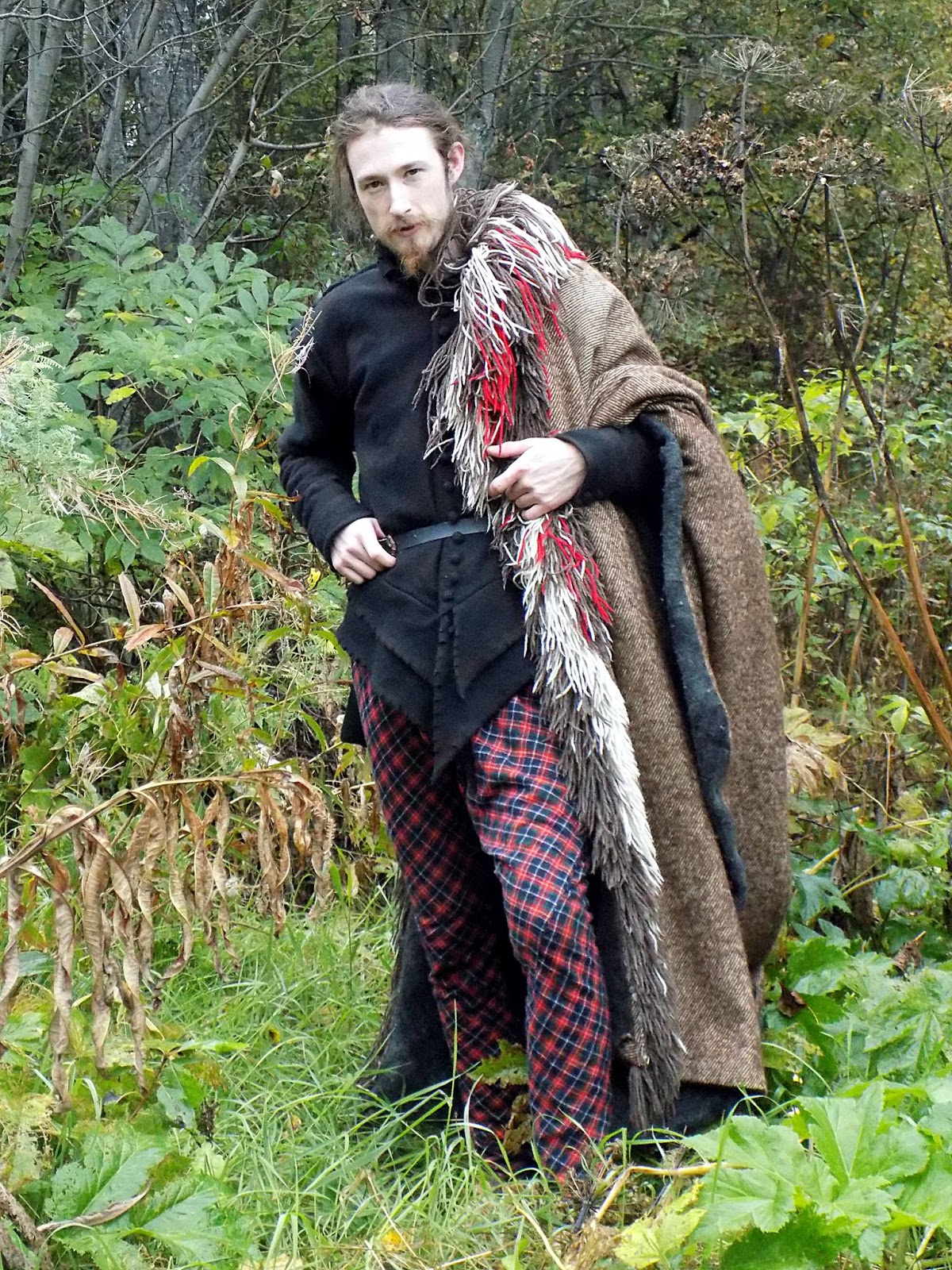
Obnoxiously Plaid Skinny Pants and the Irish: The Dungiven Trius Documentation

I am extremely happy to say that this is the end of a fairly long project.  Not the trius, which are the principal subject of this post, but the Dungiven Suit project in general:  making the garments--consisting of doublet, trius, and shoes from the Dungiven find.  I chose to leave the brat/cloak of the find out of my recreation because I already have a late period Irish brat made, albeit with wider material.

This project is a pair of trius--close fitting Irish trousers--based and patterned from those in the Dungiven find, in Northern Ireland. 

Photo by Travis "Twobears" Abe-Thomas.  Trius are being worn with the full outfit*.

Wednesday, August 3, 2016

Early Front Fall Trousers...Code Name: Hobbit Pants

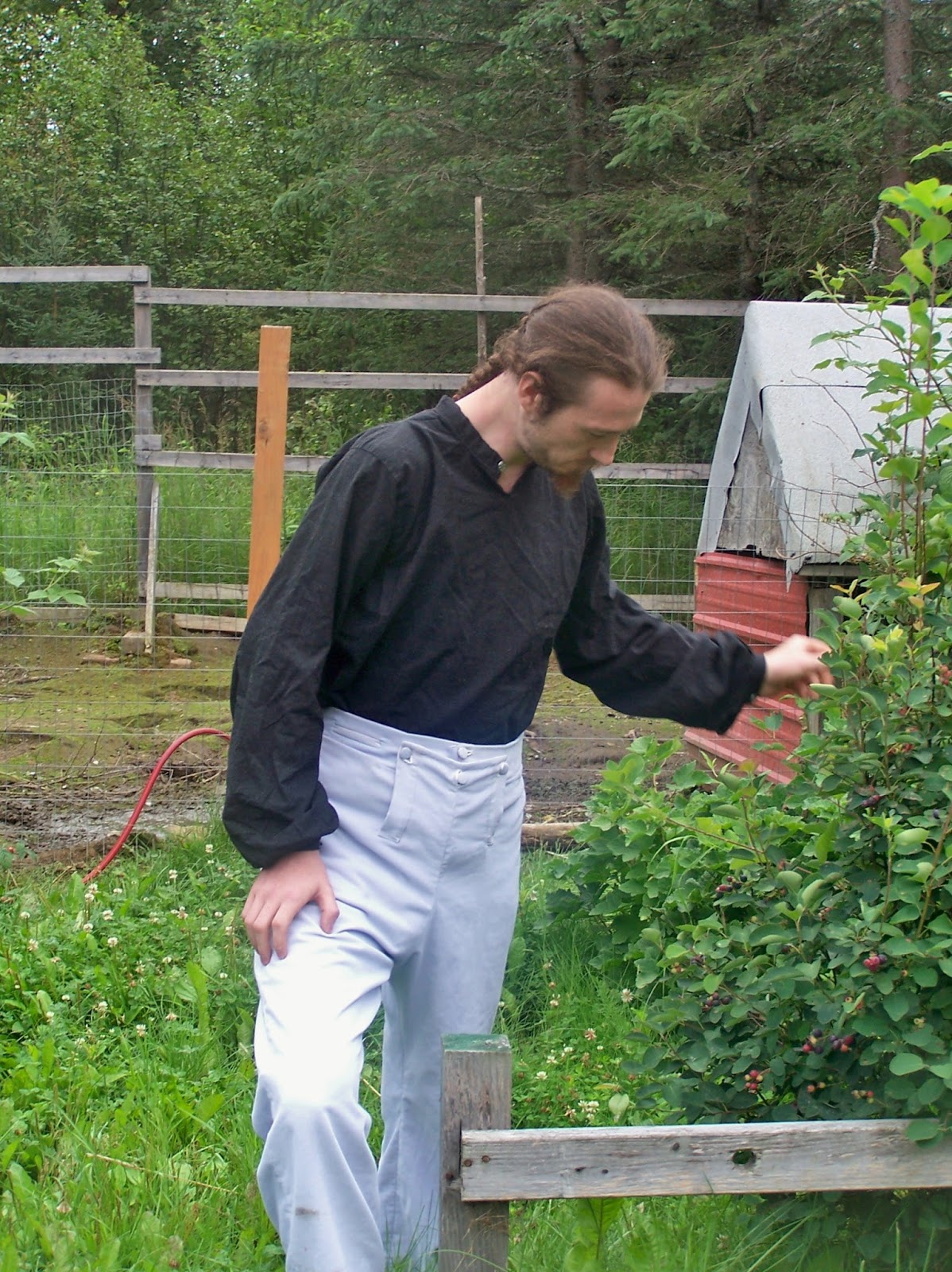
For the HSM (link to the right, as always) Monochrome challenge, due at the end of July, I decided on a pair of narrow fall, front-fall trousers in white corduroy.


This particular project was actually fun, actually; fairly simple, and new enough to not be boring.  When I ran across a pattern drafting manual by Amanda Jones from 1822, I simply had to make something out of it...and since I both needed a new pair of relaxed pants (which fit well enough in the waist that I wouldn't need a belt), and eventually need to make a pair of narrow front fall trousers to go with my Wanderer Frock coat. So my "Hobbit pants" project was born, as a practice piece.

Wednesday, April 20, 2016

Revenge of the Pluderhose: The Panes of Torment

I'm kinda seeing a trend in how I feel about the garment, here *looks pointedly at the title*.
This, the second of the series of posts on the making of /period/ pluderhose, deals with the panes and lining....originally, I was going to include the codpiece in this post, but I suspect that it wouldn't be a bad idea for it to get its own post.  I will not (yet) be showing how to do the lining--that is, the poofs; that particular set of images will wait until I actually begin construction of the garment--they are not exactly complicated, and use a lot of fabric.

Now, if you are reading this, I hope you've been following along and already have drafted the foundation breeches from PART I.  If you have not, you should go there and make them forthwith, because you build the panes from the foundation breech pattern you've already fitted. Strictly speaking, the foundation breeches aren't 100% necessary--the Svante Sture pair doesn't seem to have them, and longer pairs may not have them; so if you are doing without, you will more or less follow the directions there, ignoring the taper of the legs.

If you are doing this correctly (ish, being as there is no true way) there is little shaping of the panes, and what there is follows the foundation breeches; what this means, is that we will be cutting from the panes to give some of the shapes..  However, the pane length is at least 15% more than that of the foundation breeches--I made them closer to 30%--, to allow the draping.  Like the foundation breeches, I am basing it on Erik and Nils Sture's pluderhose.

At some point before beginning, you should decide how many panes you desire--I have seen examples that (appear to) have anywhere from Four to Seven.  Five appears to be the most popular number, however.  More panes would, of course, require more fabric in the lining since you will have more sections .
DO NOT CLICK THROUGH THIS IMAGE.  It is an unsecured page, and a virus popped up when I did.:
Seven Panes!
Joachim Ernst von Anhalt by Lucas Cranach the younger, 1563

Joachim Ernst von Anhalt by 
Lucas Cranach the younger, 1563. 
Four Panes

Brunswick man on foot
Brunswick Man. 1573. Five panes.


Friday, January 29, 2016

Revenge of the Pluderhose; the Madness Returns

UPDATE 3-19-18: I am currently reworking this drafting system to streamline and make it a bit simpler to measure.  While I was going to just edit this one, I will have to take all new photos as well, so I will work on publishing a fresh version (which will be linked here).  I did change a few things before I made this decision, so if this makes less sense than you might think, then it's my bad.

This is the first of an intended series of posts on drafting and making up a suit of German (or Swedish) Renaissance men's clothing.  Later in the century, that is--Elizabethan era, not Lansknecht--although the patterning could be used for that as well.  Last time I wrote on this, it was part of a mad frenzy of sewing the Svante Sture suite

The garment is somewhat complicated, and I am sure has been the cause of many grey hairs in reenactors--partially because there are no patterns or instructions for them online (ok, there is one, but it is not remotely period--it seems to be based on pajama pants).  Reconstructing history also sells a pattern, which I have no experience with, and no desire to.  So, when I (for some unknown, warped, reason) decided I wanted to make another suit, I figured it would be a good thing to show how I draft a pair, since last time I made them I didn't have the blog.  Plus, the last pair didn't have the foundation breeches.  This pattern is based on the pairs worn by Nils and Erik Sture (mostly Nils, because Erik's pair of foundation breeches is stretched in a way that happens with the sewing.  You'll see).

I figure it will take around three parts--one each for the foundation breeches and the shell, and one on making them up.  The foundation breeches were made of a fine leather, similar to chamois or a soft deerskin--sadly this isn't an option for me, and I will likely use a heavy cotton (either canvas or ticking).  Depending on the particular style, the foundation breeches can be full length (and sewn to the legband at the bottom), as in Nils or free at the bottom (as I believe Erik's was).

Arnold, Janet. Patterns of Fashion 3.  Pp. 64

Monday, June 16, 2014

Pluderhosen: Some assembly required

Pattern Traced from Patterns of Fashion, by Janet Arnold.

Continuing on from my last post--A Road To Madness--I believe I managed to rectify my mistake, by extending the dart into a seam going the full width of the piece.  This will result in the back panel being slightly shorter (around 1/2 inch, since I'm using as small of a seam allowance as I may), but that should be acceptable---that piece 1/2 inch shorter than it should, should not be noticeable.

Here, you can see the modified dart (left) and the original plan (right).

Wednesday, June 11, 2014

The (A) Road to Madness: Take the exit marked...Pluderhosen?

Over the last two days I managed to fully assembled the Sture doublet, with two major differences off of the original: It untrimmed (for now.  Strips of silk will eventually be applied), and I left off the shoulder wings because I quite honestly do not like the things--I don't like drafting them, I don't like wearing them, and they add a fair amount of thickness to the seam (at least with these fabrics)
There were a few issues in the making up, with ease (which was remedied once I got the bright idea to measure off of my existing doublet), mainly.  These were summarily overcome, and all that is left is the hook and eyes (and someday trimming)


But that is not what this post is on.  This particular post is on the Sture Pluderhosen, a maddening pair