Showing posts with label Article. Show all posts

Sunday, June 30, 2024

Demystifying Documentation; How to Infodump with (some) Organization


Full Notes for the Class, taught June 22, 2024, West June Crown A.S.59
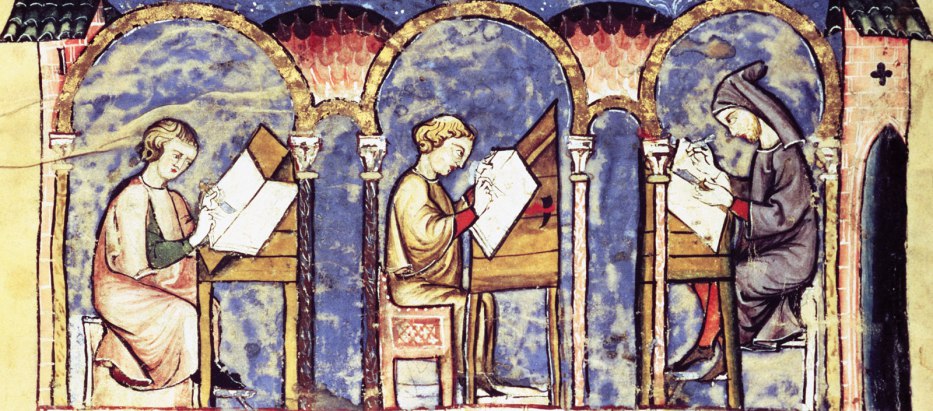
From Biblioteca de San Lorenzo de El Escorial, Madrid, Spain, c. 14th century AD

About a month ago during a conversation her (current) Highness of Oertha, Mistress Elena Verch Ryse suggested that I actually teach a class on how I do write-ups and documentation for my projects.  I thought about it (getting heavily distracted from my book as I essentially gave the lecture to myself), and decided that yes, this was something I could do and would schedule for West June Crown--a fairly major stepping point for me as I have thus avoided lecture style classes and stuck with more hands on ones where I didn't have to talk as much. 

The class went off with a small handful of brave souls--not as many as I would have liked, although there were two other classes going on at the same time, as well as something called "dinner".  As though a meal is needed after grazing all day... Still, it was a good class and we mostly stayed on topic, with a bit of perusing my library after. These are the class notes with everything I remember discussing; while my outline has been published before on this blog, I didn't discuss my theories in depth at all.  This particular class does not focus primarily on writing for competitions as most articles on the topic seam to, but more for writing to document it for your own personal gratification and to educate those who come after.

Sunday, April 7, 2024

GUEST POST: Preservation of Leather Artifacts in Archaeology

That's right...a rare guest post on Matsukaze workshops; my Apprentice's partner wrote out this gem, and I offered to host it until (and if) he creates his own webpage, as it's useful and well written information--plus it's far easier to share a webpage than a document.  Factors for preservation for organic materials is something which I have regularly needed to reference when recreating or discussing archaeological finds.
        Maistre Bran


Preservation of Leather Artifacts in Archaeology

Leather artifacts bear crucial information on past civilizations, craftsmanship, the norms of society, and daily life. However, organic materials, mainly leather, are prone to several problems that hinder their preservation at archaeological sites due to their sensitivity to environmental conditions. The scarcity of preserved leather at archaeological sites poses enormous challenges to historians and conservators. This scarcity is not by chance, but by a combination of environmental conditions, including the composition of the soils, moisture levels, and the practices of burying artifacts. This study will explore some of the factors controlling leather preservation at different archaeological sites. It will give insight as to why leather items survive across the timeline versus other perishable materials. This study reinforces these factors as the best-understood contribution of environmental and human influences to archaeological survival by comparing extant examples from the Birka, York, and Vindolanda archaeological sites. Through this research, we aim to shed light on the complexity of ancient leather conservation, which will be the first stage in a journey to acknowledge the selective nature of leather discoveries.

Wednesday, September 18, 2019

A Brief Discussion on Men's Stays


Corsets, stays, posture improvers, health belts....these are a few of the various terms for what I am discussing in this long awaited article.  Each may be slightly different, but all have the effect of narrowing the waist (or containing it, in the case of King George IV), assisting or forcing better posture, or helping support the back much like a modern weightlifting belt does.  In this article, I will be showing a variety of styles from different periods, and discussing them a little. I am /not/ looking deep into the extreme of tight lacing, or all the caricatures of Dandyism which are focused on by other articles, although I will touch briefly on them.  These phenomena existed--there is no doubt about that, given the prevalence of mocking them--but my topic is more the common (if a bit vain) man who needed a bit of help with the fashionable shape, or wore one for back support.

The Invicorator Belt for Men,
1893 English advertisement.

Friday, October 20, 2017

Pinterest for the Researcher


First Published in the Oerthan Chronical, 10-17.

Disclaimer: My focus is historical costuming, and I research most periods, not just pre-1600….and there are a lot more post 1680s extant pieces in museums.  But I will try to keep this as general as I can.  Hopefully these hints help!

Figure 1

Many people say to stay away from using Pinterest as a resource for your research.  Obviously, since I’m writing an article on it, I feel somewhat differently; it /can/ be used as a useful source of information…if utilized correctly.  So I composed this batch of advice, which should help keep you from the dreaded Pinterest – Tumblr loop.  However, it basically boils down to…:

Sunday, July 24, 2016

The HSM 2016; Challenge No. 8: Patterns

The Historical Sew Monthly challenge for the month of August is Patterns--all the varieties of patterned fabrics, and the garments which feature said patterns.  A vast subject, as I found when I volunteered to write this inspiration post--I mean I knew it was large, but this is almost ridiculous.  I will be doing my best to include things for everyone, and barely touching on the history of individual patterned fabrics.

Late 13th Century Lampa brocade.  Italy.  V and A

Thursday, March 31, 2016

Documentation: A Bibliography and Bonus Outline

Some time ago, I found that people didn't realize that there are resources out there on writing documentation, either for competition (which is the general focus) or just because you're interested in it.

I am not going to tell what is required--a number of articles have already been written, by people with more experience than I.  However, I will give my thoughts each of the various articles; plus, below the links there will be my personal outline, which I use to ensure I don't forget anything. 


Thursday, July 16, 2015

Buttonholes through the Periods

Updated 11-4-16: 16th Century buttonholes.


Some time ago, I began to wonder: How do buttonholes differ in construction throughout history (up to the modern day)?  So, I began searching, looking at some extant garments for clues--what I found was rather interesting (hence the article on them).

It appears to be rather difficult to find exactly when buttonholes appeared on European clothing--conventional wisdom (i.e. "everybody knows!") has that buttons themselves have been used as a fastening--for a tunic neck, or Russian svita--but with a loop fastener, rather than a hole sewn in the fabric.

I'm actually finding it rather difficult to track down when they appeared in Western Europe (supposedly, they came from the East, either near or far.  However, I cannot yet document this). The typical form of clothing of the 13th Century just didn't call for them, since it was generally loose.

However, in the 14th Century, they pop up--the earliest effigy I see is from 1319.
Germany Wurzburg Burgerspital Johann von Steren 1319

Saturday, March 21, 2015

Drafting Patterns from Extant Garments


Ever wondered how to take those line drawings of an extant garment—like those Medieval Garments Reconstructed, Marc Carlson’s database, or Patterns of Fashion--, and make it fit you, while remaining as true to the original garment as possible? Or better, photographs of the garment itself and figure what shape the pieces are?  
            This is the method I used for most of my major projects; The Sture Suit, G63, and most notably my Moselund Kirtle, as well as a number of projects which are planned but not constructed.

            A point on terminology for reconstructing garments (this is what I use): A museum replica is a piece made entirely with the correct technology, to be as close to identical to the extant piece when new (as possibly).  A working replica (what this class is geared towards making) is patterned from, and maintains the proportions of the extant as much as possible while having it fit you, as well as construction and definition; however, the fabric might not be spun/woven to order.  "Inspired by" I do not consider to be reconstructing a garment--you may be making a perfectly good, period piece, but the goal isn't to get as close to a specific extant garment as possible.

Thursday, June 19, 2014

16th Century Irish Dress


           I feel that claims that Irish clothing changed very little over time are completely false.  A 4th century Irishman did not wear the same thing as 10th, who didn’t wear the same as 14th, which certainly wasn’t the same as the 16th—which is what I will cover in this article.
           There are common elements throughout—such as the leine gel, the white or saffron dyed linen shirt; the wearing of the Irish Brat, or large, fringed, cloak—a garment which seems to have been truly omnipresent[1]; and the predilection to wearing tight, or no pants.  In addition to the Irish styles of dress, English and Continental fashions were also slowly adopted (often with the addition of the brat), and were more prevalent in major cities (particularly port cities), among the upper class, and later in the century.
           Throughout this period the English rulers (Henry VIII…) attempted to enforce freshly created laws forbidding Irish modes of fashion, and haircuts—this is one of our prime sources on the essentials of Irish clothing.  Articles targeted were the glib hairstyle, women’s headwear, the dying with saffron, the  amount of cloth used in the leine, and ,particularly, the Irish Mantle (with its fringe).
Men’s Clothing
Leine:  This (in various forms), along with the brat, was one of the two main articles of Irish dress throughout the ages.  The leine was invariably made of linen, likely a heavier weight, tightly woven type than is commonly available today.  The colour by this time was almost invariably saffron dyed yellow (a bright yellow)--or natural for the destitute.
           The leine was usually long—ankle length—and bloused over the belt in order to pull it up to knee level and allow greater freedom of movement.  Necklines seem to have been roughly ‘V’ shaped and often fairly deep.  I believe that they were probably rounded in the back, making the neck opening a loose teardrop shape when laid out flat during construction.
The sleeves of the leine were very wide at the cuff, often hanging to the knee—but were narrow at the top[i].  An interesting evolution on these is that though the sleeve itself is very wide at the cuff—they were not necessarily very long.  Several images show the sleeve stopping just below the elbow, presumably to give greater freedom of movement and reduce the chance of entanglement I believe that at least occasionally the sleeves were full length, and in the “bagpipe sleeve” style.

Monday, April 14, 2014

Thoughts on the Chivalric Virtues


The Following are my personal views, and beliefs, and are not necessarily indicative of how things really are.
 
Chivalry: There are nearly as many versions of the Code of Chivalry as there were orders—perhaps even practitioners.  Some of the virtues, the ones I will be addressing, are Prowess, Loyalty, Largesse, Courtesy, Truth, Temperance, Justice, Faith, Courage, Honor.  My goal is to discuss the place of the various virtues in the SCA, and how the various ideals relate to each other.
 

Prowess:

              Prowess has always been important to the Chivalric ideal.  It is a way to gain renown, status, and even a means of support (by means of the ransoms gained with prowess).  Prowess is typically measured by skill in various forms of combat; whatever the current fashion is. 
              While you cannot particularly support yourself in the SCA by means of your prowess (unless you’re smart about it, like Sir Gemini with his school, or various craftsmen who sell their wares) the other two are quite common.  Renown is fairly simple—if you are known as a good fighter then people will talk about it and eventually you will become known for being able to defeat (or skewer) your opponents.  Likewise, status may be gained in the form of winning a crown tournament or earning a knighthood.
              However, unlike in period, I think that Prowess can be more than “just” fighting (I suppose you could gain fame and renown by being a famous armourer or poet.).  You can also gain renown by means of becoming skilled at various arts; or, on the service side—perhaps by your skill at herding assorted sizes of cats…  It is, however, a bit more difficult to gain status by means of arts or service—there are just less options (Barony of the Far East withstanding). 

Monday, March 10, 2014

The Wound Man


The Wound Man Illustrations
 
The Wound Man is a form of illustration which appeared in late 15th through 16th century medical texts.  This poor, illustrated fellow is covered in various injuries—arrows and swords stuck in him, clubs and hammers imbedded in his skin, and spears perforating various parts of his anatomy—all of which were (theoretically) treatable by a learnéd surgeon.

The Wound Man, from the Feldtbuch der Wundartzney by Hans von Gersdorff, 1517.  Oil on Canvas.