Showing posts with label Frock Coat. Show all posts

Monday, July 11, 2016

1860s "Sailor's" Topcoat; Travel Challenge

 
I really don't try to do these poses.  And it really does help your balance--I was walking on a submerged log.

The Project:

This was actually a fun project, and fairly quick once I got it drafted--a topcoat made of a single layer of canvas.  No shaping, and little handwork beyond hemming and sewing the various facings down (and buttons, of course.  Those don't count since they are a given.).

What it is is a slightly rough coat made of canvas, and made to the pattern of the very early sac coats or a semi-in-between garment known as a paletot (which clearly evolved from the frock coat, and is a semi-fitted overcoat).  Because it is only made of a single layer of material, and has no shaping--and isn't closely fitted--it is a quite comfortable garment for hot weather...something I rather needed.

Thursday, March 31, 2016

Bibliography of Historical Tailoring and Cutting Manuals

To the best of my knowledge, there is no place online that gathers the various--freely available--Victorian and earlier cutting systems.  Professional tailors--and cutters, which is a separate job, often in the same shop--use cutting systems rather than actual patterns.  The main difference, of course is in fit and style--a pattern may come graded to a number of sizes, but these are still ideal and won't necessarily fit; cutting systems, on the other hand, use scales and mathematics to give proportions and how to draft for the body of the customer.  They typically also have notes on modifying the draft for varying postures and such.  The majority of the systems were for menswear, and that is my focus--however, there were variations for tailored ladies' clothing as well, and I will include those that I find.
From E. Dilday's Plain and Concise Method of Garment Cutting, 1856

Sunday, December 20, 2015

Featured Garment; An Early Frock Coat?

Last week we went to 1330s Genoa, with a rather interesting cioppa.  I had a devil of a time deciding exactly where to go this week--I just couldn't seem to find anything that piqued my interest.  Then I remembered a garment which caught my eye months ago (or however long since I first started using pinterest)--and extremely early example of a frock coat.

This coat, from Eastern Europe, dates to 1815--a good five years before the frock coat as we know it is supposed to have come into existence--as popular knowledge has it, anyways.  In reality, it existed on the continent before that--it just took a little longer to reach the shores of merry old England.


Tuesday, December 1, 2015

Franken-frock Coat: It's Aaaliiive!!

Almost...done.  When I last last left, I was discussing the pockets, and mourning the fact that I apparently did not take any pictures of the semi-complete garment.  So, an overview it is.

To recap, my Frankenfrock is a frock coat made of 11 different wools, patchworked together; all of the shell materials were upcycled from blazers I purchased at the thrift store.  When I designed the garment, it was partly because I wanted a unique coat, and partly for the challenge of pattern matching and forcing myself towards precision in sewing my seams (the other option would be making a quilt...which just doesn't appeal to me).

Monday, November 16, 2015

Featured Garment: 1820s American Surtout

I decided--inspired by the Dreamstress, if you are familiar with her blog (if not, it's on the sidebar the right of your screen)--to start doing a weekly "Featured Garment".  For the most part, these are likely to be a piece of men's clothing that catches my eye--whatever period it may be.

For the first one, there is a fascinating wool early surtout--a frock coat--from America, that is up for auction.
The Auction house has this to say:
Beige wool broadcloth, fitted through chest, tan velvet collar & turn back cuffs, diagonal double row of brown thread buttons, side & F waist seam, double pleats to wide back skirt, CH 40", L 39", (1 tiny hole, velvet knap worn & torn, sleeves enlarged w/ inset beige wool gusset) very good. James Kochan - Don Troiani Collections
The piece caught my eye because of the low pockets--to start with.  Other things that caught my eye are the extra long cuffs, lined with the same velvet as the collar, and made to be turned back--also note the position of the three buttons on the cuffs.

Friday, July 10, 2015

Installing a sleeve vent

One of the things I found when I went to make my first couple frock coats is that there roughly no tutorials on exactly how you put together the vent on a working suit sleeve.  So, during the process of stitchripping over a dozen assorted blazers for the Franken-frock project, I paid attention to how the sleeves were constructed.  I'm not saying this tutorial is the only way to do it--or even the right way--but it'll work.
    None of them had working buttons, of course, but the construction is close enough--the main difference is in the lining.
   
 Alright.  Your sleeve pieces should look approximately like this.  When you draft, you need to add enough length to double up on the vent.  If you didn't, you can always sew on a piece to be the facing.

Thursday, July 9, 2015

Latest project, Unveiled. The Franken Frock (coat). Part I

Most people already know about this--it's not exactly a secret--but I have not officially announced one of my latest hare-brained schemes.  Since November I have been gathering materials, and am finally beginning to work on assembly.

A single breasted Frock Coat, based theoretically on the 1870's patterns (mainly the lapel shape), in a patchwork of tweeds I am upcycling from blazers found at the thrift store.  I have affectionately dubbed this project as my "Franken-Frock".  I've seen a few examples of patchworked coats, and personally have found them all to be hideous, with large pieces of material used in random places.  In comparison, part of the point of this project is to force myself to higher accuracy in stitching, since if I don't the pattern will get slightly askew (i.e. Let's challenge myself with pattern matching).

Friday, June 6, 2014

Drafting a Frock Coat, part II: The Sleeves

Drafting sleeves--one of the banes of my existence.  Like in the first part of the tutorial, I am going to translate and provide step by step photographs of the process.  To find the measurements needed to draft the sleeve pattern, you need to have the body pattern drafted...or, as I am using, made up in halves (I recommend the first).

Page 13 of the Cutter's Guide
Page 14 of Cutter's Guide


Page 15 of the Cutter's guide...the last of the instructions.


Start off by measuring the width of the scye.  This is done by placing the ruler horizontally (or squared to the back seam) at the side-body seam.  Like Thus.


Measure down from point 'O' by this amount.


Here, it starts talking about finding the pitch.  Mark point 'A' 3/4 inch above the bottom of the scye (Forearm seam).  Mark point 'B' (Hindarm seam), the back-sidebody seam, or to taste.  Because the difference between the front and back is so drastic on mine, I decide to put 'B' one inch above the shoulder seam--actually on the front piece.


Tuesday, May 6, 2014

Drafting a Frock Coat, Part I: The Body (and Skirts)


The Orders are as follows. 


Start by marking off a straight line (Line 1).  Mark points at 1/3 depth of scye (plus 1/2 inch, to taste), at depth of scye, natural waist, and fashion waist (which is 1-2 inches below the natural waist--no lower than the hip bone).


Mark in 1inch at the natural waist, and draft a line from point 1 (the top of the line), to the waist.  Then straight down to the fashion waist.


And other Things: plotting a Transitional Frock Coat.

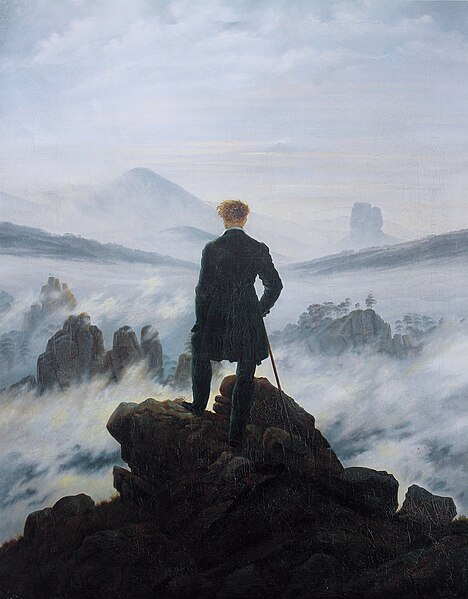
Historically Accurate?  No, not so much.  I do, however, need an outlet, where I do not have to worry about documenting nearly everything.  Steampunk(ish) things are that outlet as--even if there are no local events--I can wear the clothes daily without attracting stares (more or less, anyways).  In this case, while watching the 10th Kingdom, I noted one of the coats being worn by Wolf--a shortish (low thigh length) frock coat, in blue velvet or corduroy (no good screenshots available).  Of course, this immediately got my gears grinding, whether I wanted them to or not.  In addition, I ran across this image...


Wanderer above the Sea of Fog.  1818.
I just discovered this painting, and love it!