 |
| The one I made for myself, on it's debut expedition for mushrooms. |
Showing posts with label Hats. Show all posts
Showing posts with label Hats. Show all posts
Tuesday, September 10, 2019
I knitted a...a...
...Well, I scalped a muppet. And it was glorious...the prickly thing put up a fight, but in the end I was triumphant!
About a year or so ago I picked up knitting as something to work on during down time at my day job. I started with a couple of scarfs--the first 4th Doctor inspired Ravenpuff scarf taking all winter, then went on to a couple of hats. Specifically, a thrum hat.

Tuesday, July 26, 2016
Featured Garment: 1640s German Hunter
Disclaimer: As always, my featured garment posts are meant to give ideas and promote discussion; unfortunately, this one is more filled with supposition than usual, since it is neither my period, nor one I could find much in the way of articles on. If you do know of good quality articles on working class 1640s Low Countries/Germany--please, share!
To contrast with the last featured garment--the 1650s Anglo-Irish hunter--have another hunter from only a decade prior....but a whole different social class.
The topic this week is a painting by one Joachim von Sandrart, titled simply as November, and was painted in 1643. I chose it because--let's be honest, that looks like a wonderfully warm and comfortable outfit.

To contrast with the last featured garment--the 1650s Anglo-Irish hunter--have another hunter from only a decade prior....but a whole different social class.
The topic this week is a painting by one Joachim von Sandrart, titled simply as November, and was painted in 1643. I chose it because--let's be honest, that looks like a wonderfully warm and comfortable outfit.

Tuesday, June 28, 2016
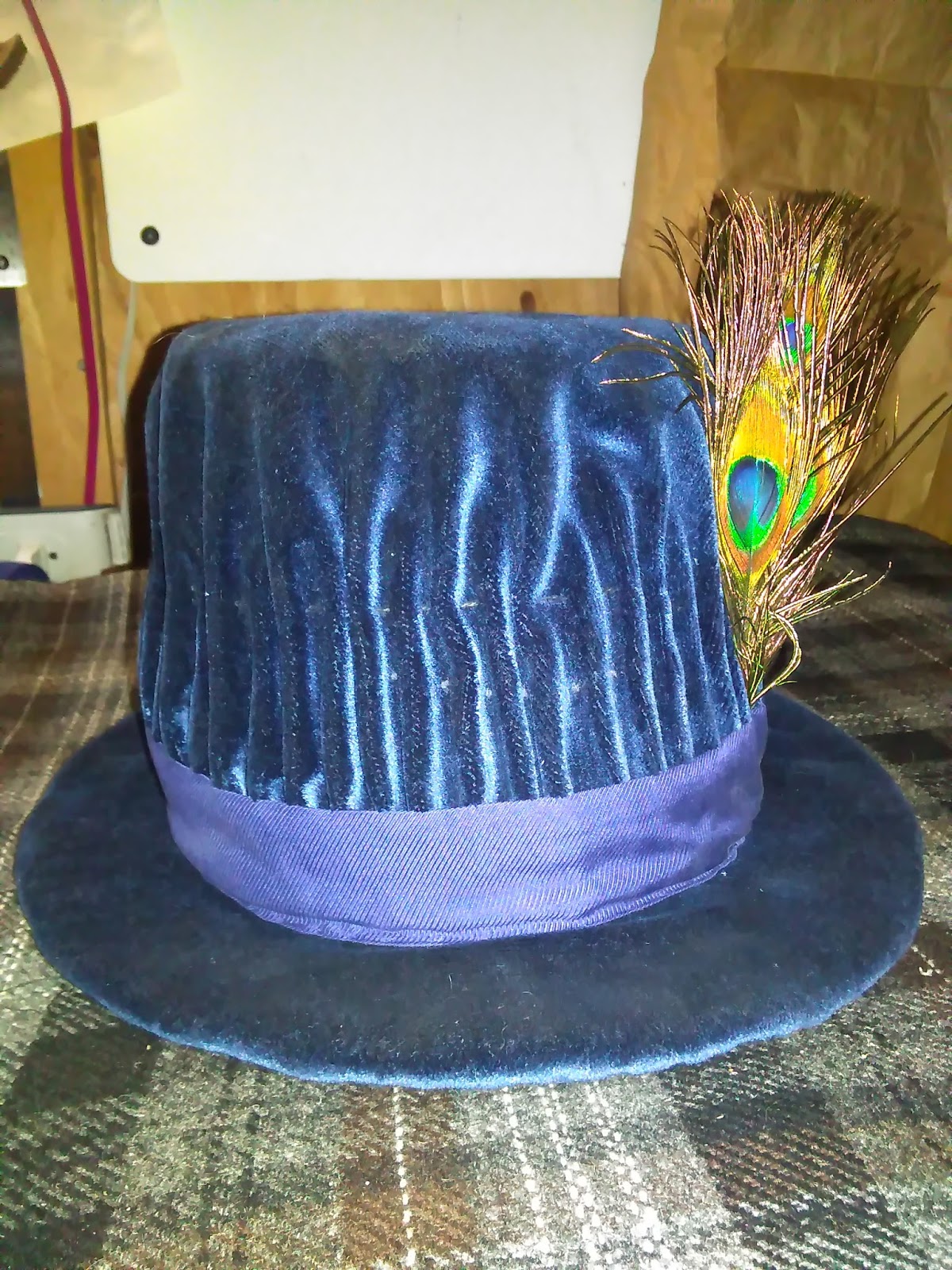
Odd Things: Woven Tophats
Some time ago, a rather unusual accessory came up for discussion on the HSM group....a top hat, woven of walebone (baleen) and rattan, from the Swedish Museum (made in Stockholm). So I decided to take a look around and see if I could find more examples; I did. No others of those particular materials, but several examples woven out of straw, or even willow. Oddly enough, I'm not finding anything written on them--don't know why. Neither could I find any fashion plates that /may/ depict them (and no, searching for summer fashions didn't work).
 |
| 1805. Met Museum |
Tuesday, February 16, 2016
1570s Tall Hat: Construction

This post is exactly that--the image heavy, step-by-step article of how I made the tall hat. It is not the Documentation, with all the information on the style and my thought process. That article can be found HERE, and should be read first.
HSM February--A Pleated Tall Hat
For my entry into the Historical Sew Monthly February challenge, the theme being Pleats, I chose an Elizabethan era tall hat. Which has, as you might guess (and can see), a pleated crown.
 |
| The finished Tall Hat. |
The Project:
An Elizabethan Tall Hat or Pleated Tall cap. This form of headwear was seen starting in the '70s (1570s, that is), for a good 30-40 years. It was typically made of a heavy felt base, covered with pleated silk.Sources:
This project of an Elizabethan tall hat was based on several examples in period artwork, but particularly on an extant example in Patterns of Fashion 3, by Janet Arnold. There are a few variations of the garment in the artwork of the period--shorter, tall, and decided crushed (which seems to be the more common in Northern Europe during the '70's). |
| Philip II. By Juan Pantoja de la Cruz (1553–1608) |
 |
| Vaandrig, Abraham de Bruyn, (1550 - 1587) |
Wednesday, December 9, 2015
14th Century Kolpak
Today I'll be going over my process and some documentation for my kolpak. Sadly, this project was a couple of years ago, and I didn't take full notes on my documentation. Shame on me, I know.
When I made my 14th century Russian garb (lovely period, btw. Quite comfortable, and warm) I needed, of course some kind of headwear. Preferably one which wasn't commonly seen...this mostly left a tall kolpak. I really don't feel like writing an article--when Sofya la Rus has already done so, and better than I can. So go read HERE...I'll wait.
Well, they seem to have "typically" been made of a stiffened felt--not an option for me, sadly; I don't have the materials to do so. So I went with a logical variation--using birch bark as a stiffener. I figured "birch is common in Russia, and was used for some things, so why not" (I seem to recall a collar stiffened with thin leather or bark).
 The first order of business was to pattern, figuring out the circumference (head, plus some ease for the fur), and the height. I then drafted a slightly asymmetrical shape that I found pleasing to the eye. Note that the curve to the bottom is necessary.
When I made my 14th century Russian garb (lovely period, btw. Quite comfortable, and warm) I needed, of course some kind of headwear. Preferably one which wasn't commonly seen...this mostly left a tall kolpak. I really don't feel like writing an article--when Sofya la Rus has already done so, and better than I can. So go read HERE...I'll wait.
Well, they seem to have "typically" been made of a stiffened felt--not an option for me, sadly; I don't have the materials to do so. So I went with a logical variation--using birch bark as a stiffener. I figured "birch is common in Russia, and was used for some things, so why not" (I seem to recall a collar stiffened with thin leather or bark).

Subscribe to:
Posts (Atom)