
Showing posts with label Banyan. Show all posts
Showing posts with label Banyan. Show all posts
Monday, January 9, 2017
Aaand I present the 1750s Banyan Documentation. ...Finally.
This has been coming for a while, but I needed to finish (...or write, period) the third post on making the blasted thing. But here it is...the documentation for my 1760s banyan, which I shoehorned into the HSM Red challenge (yes, the garment is blue...but there is apparently enough red on it to count).


Monday, December 12, 2016
Continuing on: Putting the Banyan together
I suppose I should go over how the 1760s banyan goes together, shouldn't I? All in all, it's fairly straightforwarded...however, I found that there are a couple of counter-intuitive details in sewing the lining into place. I based the order of construction, and these little details on an excellent thesis on 18th century Waistcoats (in bibliography), which I figured are closer in construction that a full coat (assuming there are major differences). Other details are from discussing an extant frock coat with someone who had it to hand.


Thursday, October 20, 2016
A Robe for Reading: 1760s Banyan. I suppose I need sleeves, don't I?
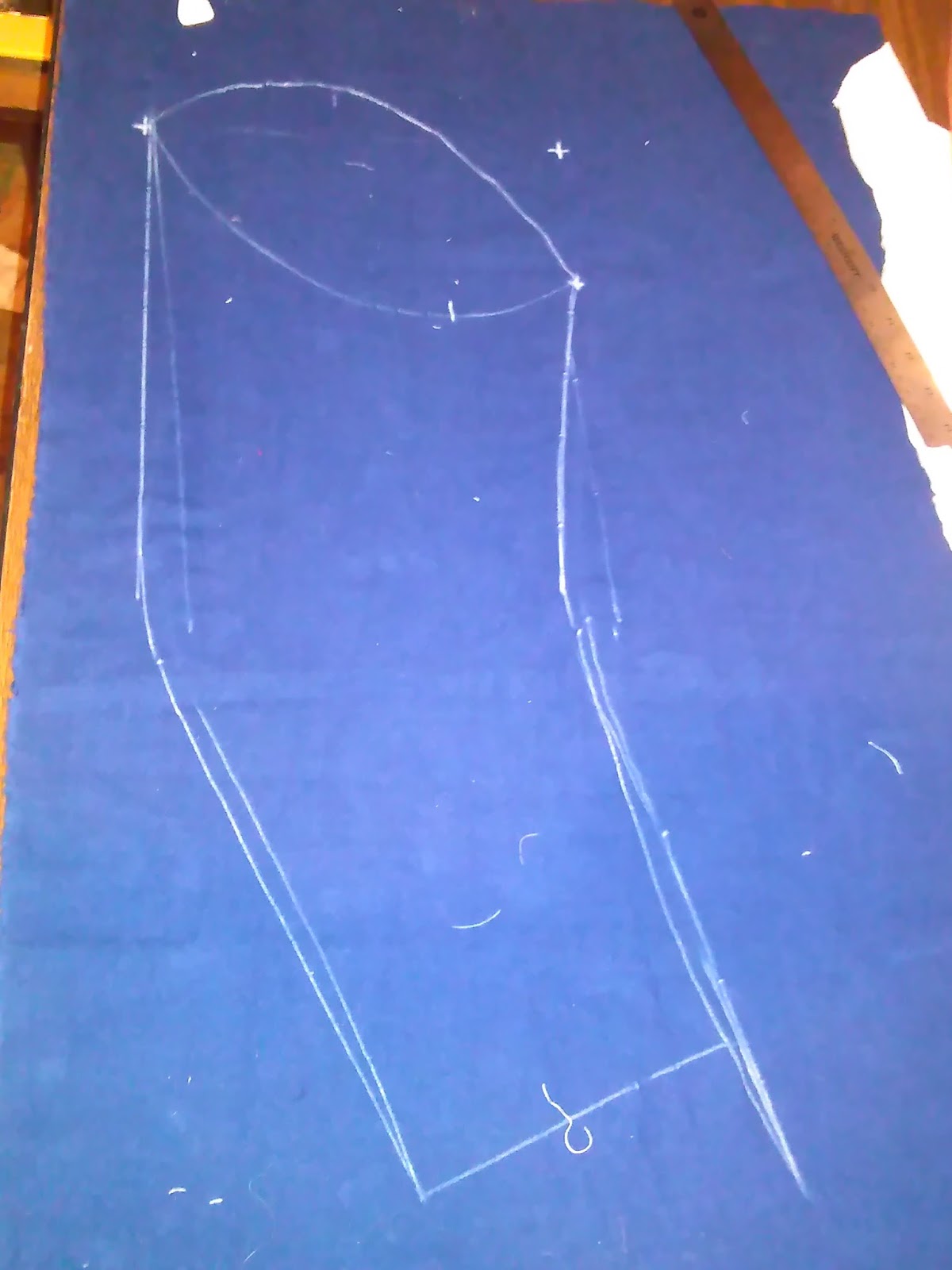
And it's time for Part Two of Three on the making of my Banyan, based on an example from the 1760s in the Los Angeles County Museum of Art. As you might guess by the title, the majority of this post is on drafting the sleeves--the cuffs and collar are both quite simple.
For a recap, this particular garment is based on the one the LACMA provided a lovely pattern and information on. However, while they provided a pattern, they do not tell you how to draft the garment so it fits you (their scaling grid is also terrible).
 The way I do sleeves is fairly simple; essentially you take the measurements of the armscye, and transfer those to your sleevehead. However, a word of warning that some parts of sleeve drafting--the hang of the arm in particular--are rather complicated, and something you will have to learn on your own (until I get good enough that I can explain it); when it comes to the lateral rotation (as swinging your arms normally) you want the top and bottom of the sleevehead to be in line with the natural hang of your arm. As such, it may not hurt to mark the low point while the body is on your victim as well.
For a recap, this particular garment is based on the one the LACMA provided a lovely pattern and information on. However, while they provided a pattern, they do not tell you how to draft the garment so it fits you (their scaling grid is also terrible).
Monday, September 26, 2016
A Robe for Reading: Drafting Mid 18th Century Banyan, Part I
For some time now, I have been planning to make a banyan from a grosgrain brocade woven of dead dinosaur (i.e. synthetics, if you aren't familiar with the euphemism) I have had in my stash for years. Not the loose, kimono style of banyan, but the variety more closely related to the contemporary frock coat. I love those things.

Subscribe to:
Posts (Atom)