Showing posts with label Handsewing. Show all posts

Monday, July 1, 2024

A Common Man's Doublet

©Travis Abe-Thomas, June 2024

Finally!  I actually finished another project, and in time to debut the suit at the second ever West Kingdom Crown hosted by Oertha.  This is the white hemp canvas doublet I have been plugging away at for the last two years, to be paired with the black wool round hose as a "working" suit which would age and develop what we're going to call "character"...also known as stains and hopefully wear patterns.

When designing the project, I knew I wanted a fairly simple outfit from the end of Elizabeth's reign--round hose, and a fairly plain doublet.  As working class people aren't the most popular subject for art (unless accompanied by quaint villages and beautiful scenery as in my Low Countries Research), I eventually found what I was looking for in Samuel Pepys's Cries of London.  

Saturday, July 22, 2023

A Procrastinated Pair of Round Hose

    Some years ago, in the Pre-Covid times, I decided I wanted to make a plain suit of Elizabethans.  Something from the very end of Elizabeth's reign, and suitable for working in; setting up tents, fighting, maybe some hiking, sitting in the tavern, etc.  A suit of late period clothing where getting it dirty would only add to the character of the garments rather than spoiling them.  In the end, I settled on a suit of round hose in wool broadcloth, and a doublet in another broadcloth or hemp/linen canvas.  While the doublet is still in the works (but is actually being worked on!), I actually finished the round hose over a year ago; I just haven't had any motivation to write (acquiring a new, functional computer helped a bit, but that was purchased *mumble* months ago...).  Wish me luck on this...I'm well out of practice on writing at all, never mind project documentation; thankfully, I took a fair amount of notes...but not enough.

    The hose are, as said, made in common man's cloths and suitable for the tail end of the 1500s and into the 1600s..  Finding exemplars was more difficult than the norm for this period, as working class people aren't particularly popular subjects of paintings, and I additionally had a particular look in my head.  In the end, the Samuel Pepys's Cries of London was a major resource and inspiration for both the hose and doublet forms.

    The Cries of London is a particular genre of artwork which often dealt with the lower classes of various cities (e.g London, Bologna).  The term allegedly comes from the "Cries" or calls of the various traders as they tried to attract customers [Payne, abstract].  In the case of the examples collected by Samuel Pepys, the collection we know as gathered up to 100 years after publishing.  The actual artist of these is unknown, as is the original date, although based on fashion style I estimate this example is from last quarter of the 16th century.

From Spitalfields Life Blog

Tuesday, January 28, 2020

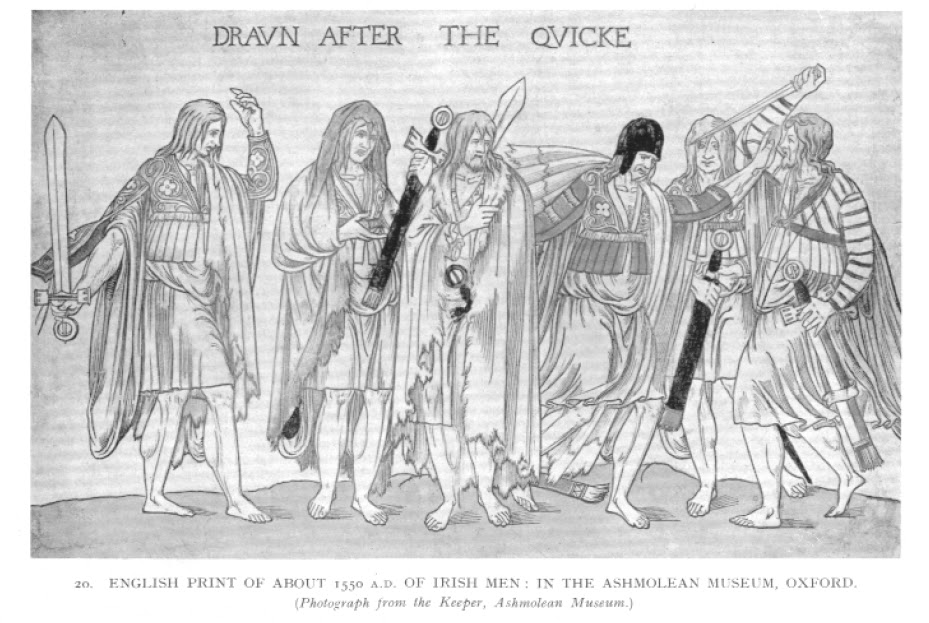
A Wild Irish(wo)man's Inar

A couple of months ago, my Donna and Pelican was asked to join the Order of Defense, the peerage for fencers in the SCA.

As she had nothing nice to wear for her elevation about 6 weeks later at Winter Coronet, we discussed options, and settled on 16th Century Irish (her Persona and mine) menswear--partly so she could borrow pieces from my wardrobe, and partly because the main outer layer really doesn't require much fabric.  So...I set to procrastinating.  For the better part of a month.  Not a big issue...even with handsewing an inar doesn't take much time, since there really aren't a lot of seams.

Photo by Twobears Photography
However, since it was for a special occasion I wanted the garment to be bling, and elected to try to keep my doing so a secret except from select support crew who were sewn to secrecy. 

Thursday, August 29, 2019

A Work-a-Day Elizabethan Shirt

Well...mostly work a day.  This project was intended to be just a shirt to wear under my late period wear; one which does /not/ have silk insertion seams as the last shirt I made does.  Even though the silk sewn shirt is fairly heavy and should be durable, my brain won't let me abuse and get it dirty as I probably will with this one.   This project was completed a good six months ago, and took about nine months of procrastinating to finish--there is a certain amount of guesswork since I wasn't doing a good job of journaling my projects during that time.

Wearing the pluderhose from my Brunswick Suit for the photos.

Friday, August 2, 2019

A Pair of Transitional Braies

Alright!  This project has been finished for well over a year, but I haven't actually worn it until recently.  I also had not written any documentation on the subject--or any other projects in the last year or two, for that matter.  I'm well out of practice in writing, and working from scanty notes and memory, so please bear with me.

Introduction:

As I have been working on a 14th century outfit (slowly), and intend to venture into the early 15th century, I needed an actual set of braies instead of the wrapped loincloth style hypothosized over on the Hibernaatiopesäke blog.  While comfortable and of a period form, I didn't feel they would be appropriate for later in the 14th century, never mind the 15th.  Therefore the first part project was to figure out what shape the braies would be, then make a pair which would work for a variety of outfits.

Friday, February 16, 2018

Plainsewing in Depth

Being the Class Notes/Synopsis of my class taught at St. Boniface Collegium (UAF) last November.

This class was intended to go over each of the sixteen or so different stitches I could think of, what uses they are most suited for, and how to choose your thread and wax...I didn't quite manage to get that all into the actual class since we kept running off on tangents. I had also anticipated more beginners in the class, rather than leading a class mostly containing experienced seamstresses. The goal of the class—and even more with this article--is to pass on some of the tips and tricks I've gleaned over the last few years of doing a fair amount of handsewing; both in SCA (Society for Creative Anachronism…pre-1603) and more modern sewing and tailoring, and to help make things easier for other historical costumers who want to do more in the way of handsewing. By no means is this article exhaustive and as I think of or learn more stitches, I will update.  Originally, I also intended to provide documentation for each stitch for each period (if it was used); I eventually decided to not do so because it turned out to be a lot more difficult and a more of a massive undertaking than I anticipated and I wanted to actually get the article published someday soon.


Supplies:

To start with, I will cover the required three tools and materials for handsewing and one optional one--this list does not include the fabric. Needle, thread, wax, and I highly recommend a thimble (semi-optional).

As you can see, I store my needles in an old Belgian Ale cork.
The jewelry pliers are helpful for sewing through many layers
and when your fingers start slipping.

Sunday, July 2, 2017

Stolen: Dwarven Vest?

Nope…it’s a 16th century Irish inar.  While the garment appears to be too small to modern eyes, the fit is actually just right…for the style.  The inar was the “outer” garment of the Wild Irishman outfit, and was worn over the loose,tunic-like leine.  To the best that I can tell, the garment is unique to the culture.


Garment Description:

The inar is a short vest or jacketlike garment, most likely made of wool.  It is slightly fitted (primitively), has rudimentary sleeves, and a separate skirt (which is also short).  Did I mention the garment is short?  It comes to maybe hip length, with the waist seam somewhere around the sternum.  The neckline comes down almost to the sternum as well.  As such, it is a somewhat odd-looking piece of clothing, especially being worn over the extremely loose and bloused leine. 


Wednesday, January 25, 2017

The Final Piece...the Tall Hat

This is it...the last piece for my 1570s Germans suit.  And boy, am I happy it's finally done.  The hat itself was a fairly quick and simple project....but I have been working on the overall project for just under a year now.  Because it is the last piece (yay!) I was able to enter it into the first Historical Sew Monthly challenge of 2017--Firsts and Lasts.

The Project:

This is an extremely tall, woolen hat, similar in profile to several examples from the period of 1570s Germany, which is part of my full suit from the same period (well, of course).  Unlike quite a few later examples, and my last tall hat, the covering is not a gathered circle, but fits smoothly over the base.

Monday, December 19, 2016

(SCA) Period Buttonholes, the Class Handout

Buttonhole construction for All; Medieval and Elizabethan Buttonholes 

Photograph by Halfdan "Twobears" Ozurson of the Buttonhole class at Selviergard Yule.
Essentially, the way it works is that the construction and form of buttonholes has changed a fair amount since they show up in the early 1300s. Happily, the changes are actually linear for once—you can easily see the evolution from the original, fairly rough examples, to the modern keyhole buttonhole. However, since this is an SCA class, I will only cover the evolution through around 1600.  The full article can be found as my Buttonholes Through the Periods.

They can basically be broken down into two parts, as you might guess; Medieval, and Elizabethan. I could probably add Late Medieval/Early Renaissance (1400s) in there as well, but since it is firmly between the other two in style and construction, I doubt I need to. Both styles are worked with a buttonhole stitch—not ever a blanket stitch--, which you hopefully know how to do; if not, you’ll learn.  All period buttonholes are worked perpendicular to the edge of the material, and fairly close to the edge.

Monday, September 12, 2016

Obnoxiously Plaid Skinny Pants and the Irish: The Dungiven Trius Documentation

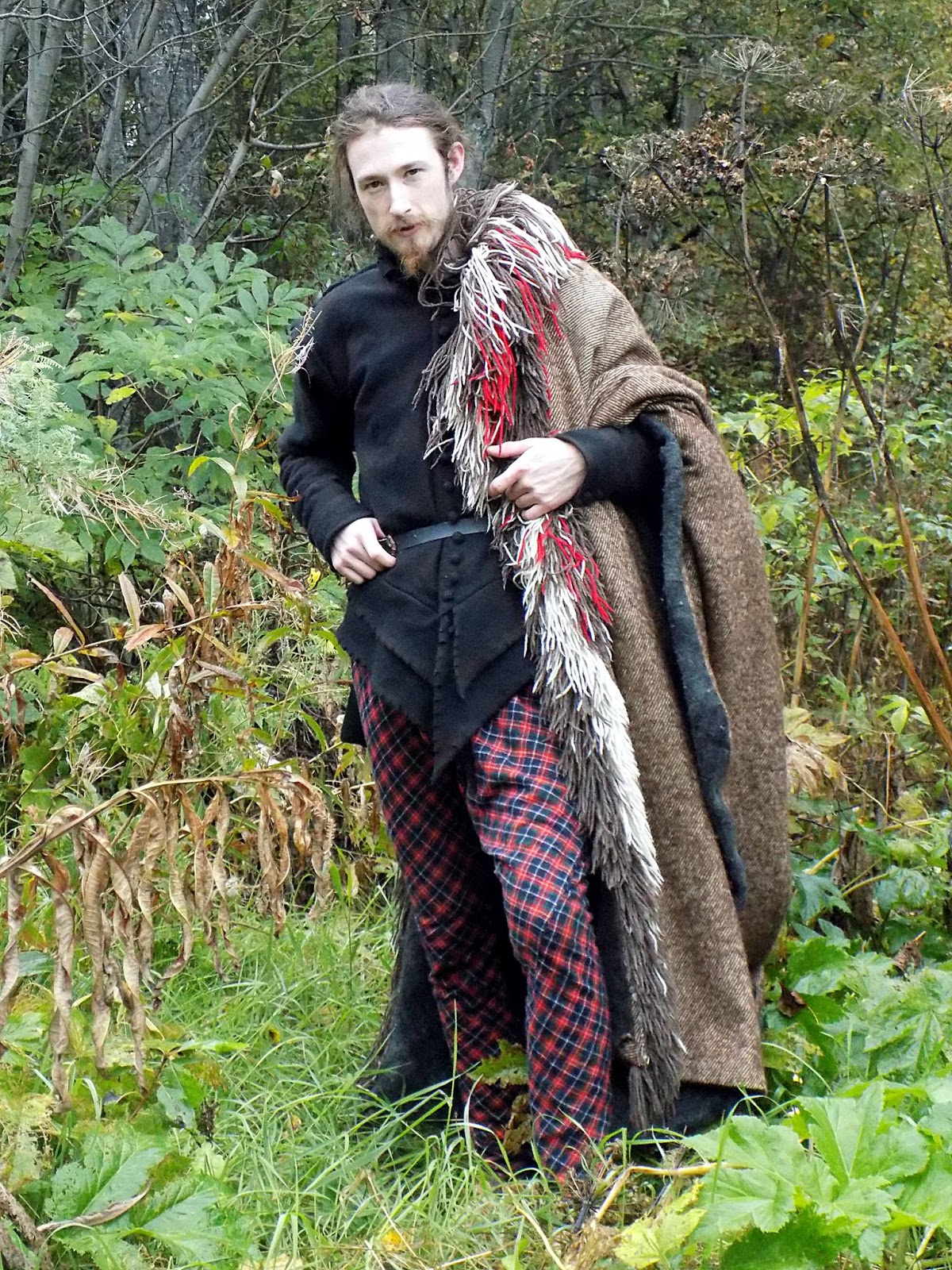
I am extremely happy to say that this is the end of a fairly long project.  Not the trius, which are the principal subject of this post, but the Dungiven Suit project in general:  making the garments--consisting of doublet, trius, and shoes from the Dungiven find.  I chose to leave the brat/cloak of the find out of my recreation because I already have a late period Irish brat made, albeit with wider material.

This project is a pair of trius--close fitting Irish trousers--based and patterned from those in the Dungiven find, in Northern Ireland. 

Photo by Travis "Twobears" Abe-Thomas.  Trius are being worn with the full outfit*.

Saturday, February 27, 2016

Norlund 78 Hood, the Finished Project

This is a project I started quite a while ago; it's been almost two years since I drafted the mockup (April of 2014).  I had to wait until I got around to making the Dungiven doublet first, because I was using the same fabric.  Anyways; this project is a slightly scaled recreation of the Norlund 78--Museum No. D10606--hood, from a Norse settlement in Greenland.  It is my entry into the Historical Sew Monthly (link to the right) Protection Challenge.

 The Find:

This garment I chose was one of a number found at Herjolfsnes, the Norse settlement in Greenland, as part of an archaeological excavation by Poul Norlund, starting in 1921.  From what I can tell in Woven Into the Earth--my main source of material--the body it was buried with decomposed to the point of uselessness, but it was found with what may have been a child sized shroud [WitE, pp. 215].  It is a vadmal sewn hood, with a liripipe, and extremely short cape.

Wednesday, December 23, 2015

Dungiven Jacket Documentation (And Double HSM)

EDIT, 5-23-16: After the original was stolen, I decided to make it again--the Dungiven Mark II.  Because I'm lazy, I'm not going to completely re-write my documentation, but add to the section with details pertinent to the second go.  These paragraphs will be written in a different font, like this header note you just finished reading.

Mark II.  It was (obviously) much warmer this time.

You are correct in believing the hat is not period--however, it was bloody cold out.
The project I chose for my Queen’s Artisan’s piece was the Dungiven Jacket—a late period woolen doublet found in an Irish bog. For the challenge of accuracy I decided to hand sew it with wool thread, and see how close I can get to the original.

The Find:
The Dungiven find consisted of a pair of trius (the Irish trousers), a jacket, and a brat (Irish variation of a cloak) dug up by a farmer on April 23, 1956. There were several other pieces found as well as the major ones—a pair of Lucas Type 5 [Henshall, pp. 135] shoes (sewn with wool thread, interestingly enough), and fragments of a belt that was found in the waistband of the trius. No skeleton or body was found with the clothing, which is not unusual given the acidity of the soil. The pieces were found slightly North of Dungiven, Co. Derry, North Ireland (the tiny red dot on the map). One of the somewhat interesting things about the garment(s) is that we do not actually know what period they are from—it is estimated based on shape that the jacket could have been make any time between 1570 and the 1640s.

Wednesday, December 9, 2015

14th Century Kolpak

Today I'll be going over my process and some documentation for my kolpak.  Sadly, this project was a couple of years ago, and I didn't take full notes on my documentation.  Shame on me, I know.

When I made my 14th century Russian garb (lovely period, btw.  Quite comfortable, and warm) I needed, of course some kind of headwear.  Preferably one which wasn't commonly seen...this mostly left a tall kolpak.  I really don't feel like writing an article--when Sofya la Rus has already done so, and better than I can.  So go read HERE...I'll wait.

Well, they seem to have "typically" been made of a stiffened felt--not an option for me, sadly; I don't have the materials to do so.  So I went with a logical variation--using birch bark as a stiffener.  I figured "birch is common in Russia, and was used for some things, so why not" (I seem to recall a collar stiffened with thin leather or bark).

The first order of business was to pattern, figuring out the circumference (head, plus some ease for the fur), and the height.  I then drafted a slightly asymmetrical shape that I found pleasing to the eye.  Note that the curve to the bottom is necessary.

Thursday, July 16, 2015

Buttonholes through the Periods

Updated 11-4-16: 16th Century buttonholes.


Some time ago, I began to wonder: How do buttonholes differ in construction throughout history (up to the modern day)?  So, I began searching, looking at some extant garments for clues--what I found was rather interesting (hence the article on them).

It appears to be rather difficult to find exactly when buttonholes appeared on European clothing--conventional wisdom (i.e. "everybody knows!") has that buttons themselves have been used as a fastening--for a tunic neck, or Russian svita--but with a loop fastener, rather than a hole sewn in the fabric.

I'm actually finding it rather difficult to track down when they appeared in Western Europe (supposedly, they came from the East, either near or far.  However, I cannot yet document this). The typical form of clothing of the 13th Century just didn't call for them, since it was generally loose.

However, in the 14th Century, they pop up--the earliest effigy I see is from 1319.
Germany Wurzburg Burgerspital Johann von Steren 1319

Sunday, May 3, 2015

Research Dump, No. 7

Norse Stamp Pattern Jewelry
A class on the design of "Viking" armbands, and pendant decorated with stampwork.
http://www.fitp.ca/articles/FITPXXI/viking_silver.pdf

Period Tailoring Techniques--making a doublet interior--part 1
An article more or less discussing the interlinings and canvassing of a doublet.
http://www.reconstructinghistory.com/blog/period-tailoring-techniques-making-a-doublet-interior-part-i.html 
Part II: http://www.reconstructinghistory.com/blog/period-tailoring-techniques-making-a-doublet-interior-part-ii.html
Part III: http://www.reconstructinghistory.com/blog/period-tailoring-techniques-making-a-doublet-interior-part-iii.html 

Rock of the Eye
A discussion on drafting patterns by Rock of the Eye (less poetically known as "eyeballing it").  There is some good ideas and thoughts in here, although it takes them some time to get there.
http://www.cutterandtailor.com/forum/index.php?showtopic=853 

Friday, May 1, 2015

1370s Blue Cottehardie. HSM: April - War and Peace.


The Project:
This project is a men’s cotehardie, from the 1370s.  I wanted a garment which would work equally well for outdoors (“hunting”) and for less formal functions—not court clothing, but certainly not low class, either.  It is somewhat more modest in length than the average for that time—however, as you can see in the German Effigy, not everyone wore garments which showed off the majority of your legs.

Base Sources:
              I based the garment on several illustrations from the period.  A couple illuminations of soldiers (or one soldier), and a German effigy.  I don’t believe there actually are any finds of this kind of garment, beyond the Charles du Bloise pourpoint[i] (which is a silk gold brocade).

BNF Nouvelle acquisition française 15939 Miroir Historial (Vol 1) Folio 122r

Saturday, March 21, 2015

Drafting Patterns from Extant Garments


Ever wondered how to take those line drawings of an extant garment—like those Medieval Garments Reconstructed, Marc Carlson’s database, or Patterns of Fashion--, and make it fit you, while remaining as true to the original garment as possible? Or better, photographs of the garment itself and figure what shape the pieces are?  
            This is the method I used for most of my major projects; The Sture Suit, G63, and most notably my Moselund Kirtle, as well as a number of projects which are planned but not constructed.

            A point on terminology for reconstructing garments (this is what I use): A museum replica is a piece made entirely with the correct technology, to be as close to identical to the extant piece when new (as possibly).  A working replica (what this class is geared towards making) is patterned from, and maintains the proportions of the extant as much as possible while having it fit you, as well as construction and definition; however, the fabric might not be spun/woven to order.  "Inspired by" I do not consider to be reconstructing a garment--you may be making a perfectly good, period piece, but the goal isn't to get as close to a specific extant garment as possible.

Monday, January 19, 2015

Phrygian Cap Documentation


Phrygian Cap

Being an entry into the Viking Stitchery Competition at Summer Coronet, AS 47


A Phrygian cap to match my new ionar, in green/black herringbone wool, lined with green linen.

Goals
This piece, aside from being a clothing accessory, is intended to example several seams and stitches appropriate for Norse clothing.  What it is not intended to be is a period perfect replica of an existing garment.


Pattern
After trying out several possible patterns, I decided upon a simple three piece one, consisting of two sides, and a circular top.  This pattern, I feel, gave me the best combination of utility (as the hat will be actually used for warmth) and drape for the desired profile.
The pattern used.

Monday, December 1, 2014

14th Century Women's Hood: Documentation

Finished Hood.

Garment Description:
This piece is a 14th Century woman’s open hood, in a style appropriate for the early to mid 1300s.  This style of hood—rather than pulling on over the head as earlier and men’s versions do—buttons up the front, allowing it to be worn open in warmer weather, often folded back.  It is a fairly standard liripipe hood design—fairly fitted and having a short mantle, with a tail (the liripipe) running from the back of the hood.
 

The find and sources:
I decided to not duplicate a period piece for this project.  However, much of my inspiration came from the London Hood, which I patterned the construction off of[i].  In addition, some of the dimensions (most notably the circumference of the hem) and construction is from the Greenland find.  While mid century examples tend to be shorter and tighter than earlier ones, I also took the colder climate into consideration—upon discussing this project with another apprentice--, I tried to design the hood so that the mantle would cover the neckline of the recipient’s dresses in cold weather.
 
 
Pieces of the Garment:
The construction is fairly simple, being only four pieces (times two, if you count the flat-lining).  These consist of: the main body, which is roughly rectangular, with pieces missing for shaping (removed from under the chin, and rounding in at the back of the head); two gores which are set above each shoulder; and a liripipe.  Looking at period examples[ii] you can see that the liripipe is usually cut as a separate piece from the main hood.