Showing posts with label Irish Clothing. Show all posts

Tuesday, January 28, 2020

A Wild Irish(wo)man's Inar

A couple of months ago, my Donna and Pelican was asked to join the Order of Defense, the peerage for fencers in the SCA.

As she had nothing nice to wear for her elevation about 6 weeks later at Winter Coronet, we discussed options, and settled on 16th Century Irish (her Persona and mine) menswear--partly so she could borrow pieces from my wardrobe, and partly because the main outer layer really doesn't require much fabric.  So...I set to procrastinating.  For the better part of a month.  Not a big issue...even with handsewing an inar doesn't take much time, since there really aren't a lot of seams.

Photo by Twobears Photography
However, since it was for a special occasion I wanted the garment to be bling, and elected to try to keep my doing so a secret except from select support crew who were sewn to secrecy. 

Sunday, July 2, 2017

Stolen: Dwarven Vest?

Nope…it’s a 16th century Irish inar.  While the garment appears to be too small to modern eyes, the fit is actually just right…for the style.  The inar was the “outer” garment of the Wild Irishman outfit, and was worn over the loose,tunic-like leine.  To the best that I can tell, the garment is unique to the culture.


Garment Description:

The inar is a short vest or jacketlike garment, most likely made of wool.  It is slightly fitted (primitively), has rudimentary sleeves, and a separate skirt (which is also short).  Did I mention the garment is short?  It comes to maybe hip length, with the waist seam somewhere around the sternum.  The neckline comes down almost to the sternum as well.  As such, it is a somewhat odd-looking piece of clothing, especially being worn over the extremely loose and bloused leine. 


Thursday, June 8, 2017

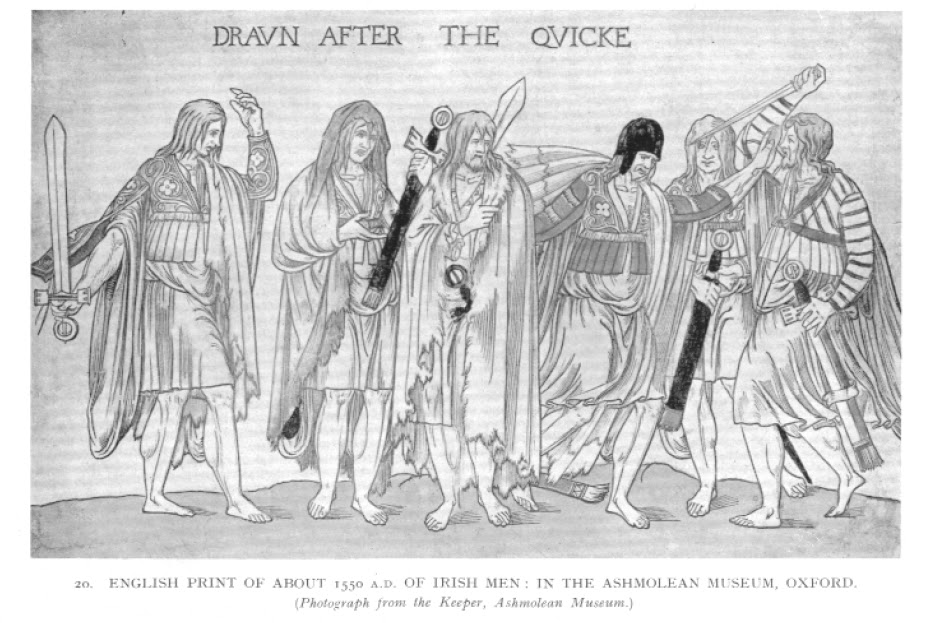
Whose sleives hang trailing down Almost unto the shoe: the 16th Century Irish Leine


This project has been a long time coming; many (relatively) years ago, I wrote an article on 16th century clothing---my first serious research article, in fact.  It is only now that I have actually gotten around to making a suit of Wild Irish clothing, consisting of the leine and inar, as well as the shaggy brat.


The Project: 
This piece of documentation discusses bottom layer of the 16th century project….the leine.

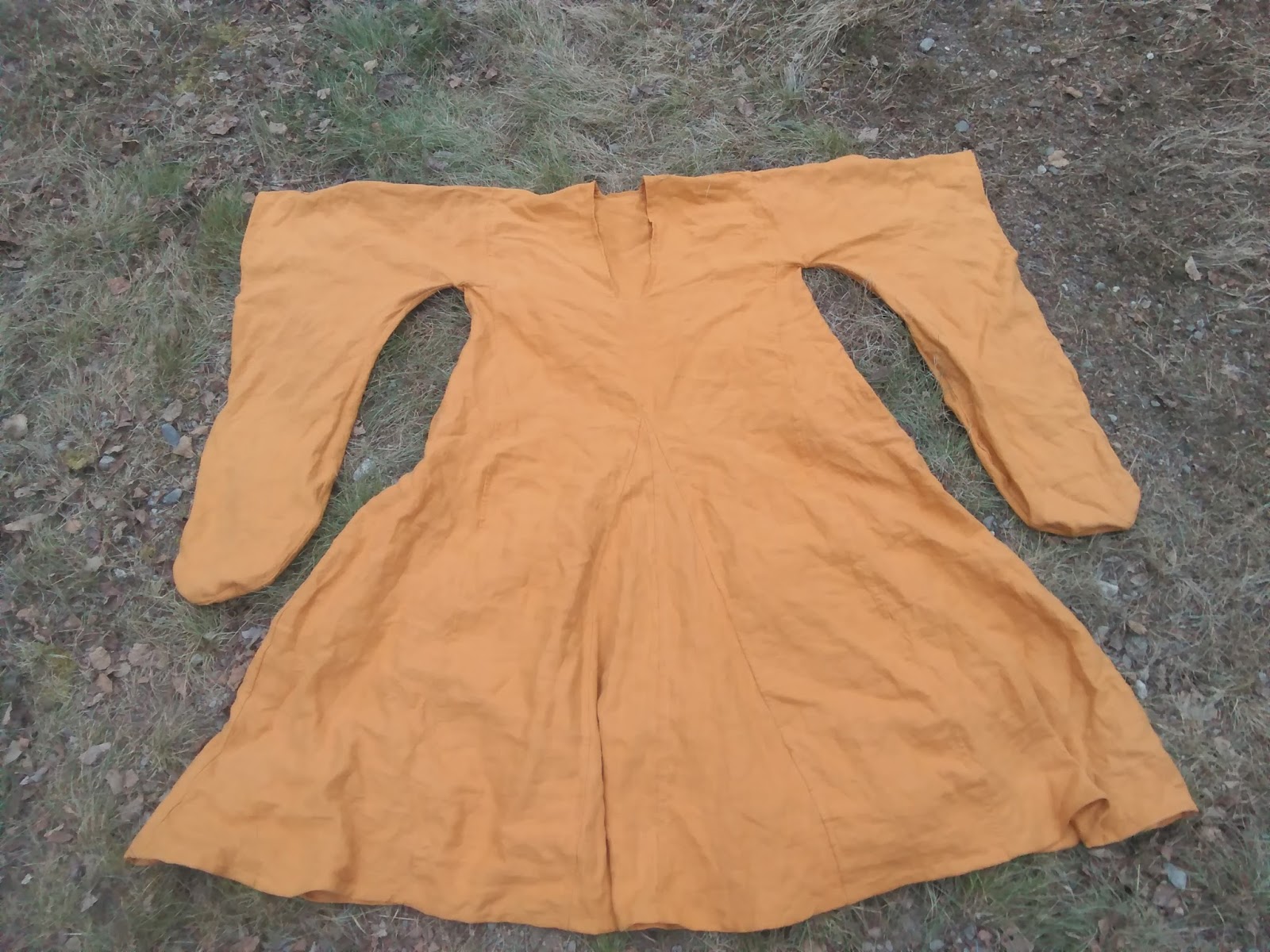
The leine--a word translating now as shirt--appears essentially as a linen tunic, almost universally "saffron yellow", although lady's versions do appear in white, and I suspect that the lower classes might make due with natural coloured linen (ranging in colour from blue-grey to a lighter yellow[i]--I will discuss this more later).  For both sexes, pendulous or bagpipe style sleeves were the norm, as was the use of massive quantities of linen cloth.  Men, at least, wore theirs bloused over a belt, to bring the garment to knee length.

Tuesday, March 14, 2017

The Other Next Project; Wild Irish

I'm also starting another project this week--just waiting on thread.  I've been planning it for quite a while...even bought the fabric almost a year ago.


 And that is: 16th Century Wild Irish.  I figured it is time, especially since I wrote the article on 16th century Irish clothing more than a few years ago.  The outfit is really quite simple; the basis is the leine of golden yellow linen, the inar of red wool, and that is essentially all.  A fringed woolen brat is also a requirement, but I made mine a good 4.5 years ago (and use it every day).  No shoes, pants, or hat required.

Monday, September 12, 2016

Obnoxiously Plaid Skinny Pants and the Irish: The Dungiven Trius Documentation

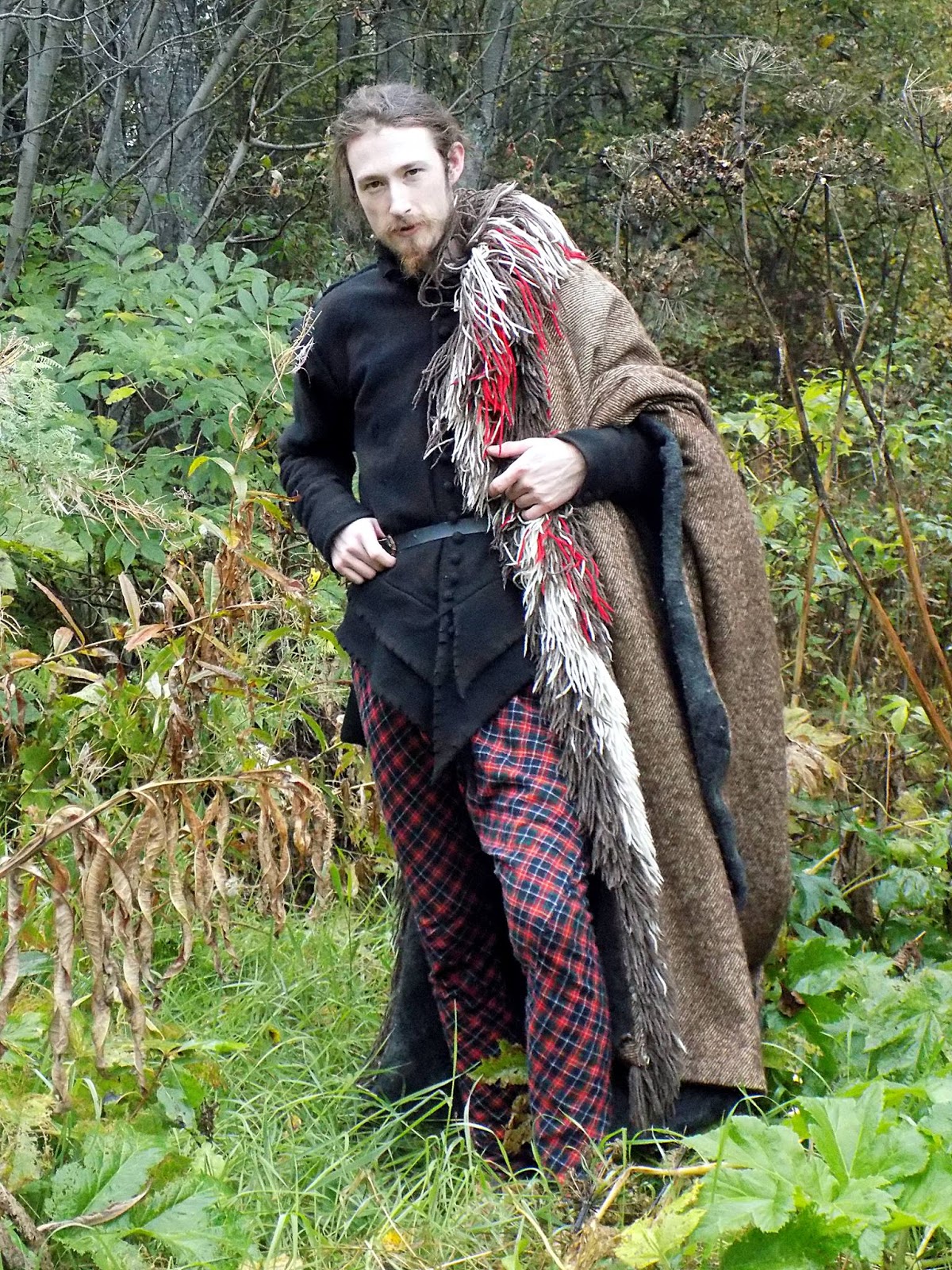
I am extremely happy to say that this is the end of a fairly long project.  Not the trius, which are the principal subject of this post, but the Dungiven Suit project in general:  making the garments--consisting of doublet, trius, and shoes from the Dungiven find.  I chose to leave the brat/cloak of the find out of my recreation because I already have a late period Irish brat made, albeit with wider material.

This project is a pair of trius--close fitting Irish trousers--based and patterned from those in the Dungiven find, in Northern Ireland. 

Photo by Travis "Twobears" Abe-Thomas.  Trius are being worn with the full outfit*.

Saturday, June 18, 2016

The Dungiven Project: Part Shoe!

The Dungiven Project is my journey to attempt to recreate--to the best of my resources and abilities--the outfit from the Dungiven find; primarily a doublet, trius, pair of shoes, and a brat. There were a couple of other fragments--including a belt--but they are not quite as important.

After a day of wear at 3-Barons Renfair.  I got a number of compliments on them!

Wednesday, December 23, 2015

Dungiven Jacket Documentation (And Double HSM)

EDIT, 5-23-16: After the original was stolen, I decided to make it again--the Dungiven Mark II.  Because I'm lazy, I'm not going to completely re-write my documentation, but add to the section with details pertinent to the second go.  These paragraphs will be written in a different font, like this header note you just finished reading.

Mark II.  It was (obviously) much warmer this time.

You are correct in believing the hat is not period--however, it was bloody cold out.
The project I chose for my Queen’s Artisan’s piece was the Dungiven Jacket—a late period woolen doublet found in an Irish bog. For the challenge of accuracy I decided to hand sew it with wool thread, and see how close I can get to the original.

The Find:
The Dungiven find consisted of a pair of trius (the Irish trousers), a jacket, and a brat (Irish variation of a cloak) dug up by a farmer on April 23, 1956. There were several other pieces found as well as the major ones—a pair of Lucas Type 5 [Henshall, pp. 135] shoes (sewn with wool thread, interestingly enough), and fragments of a belt that was found in the waistband of the trius. No skeleton or body was found with the clothing, which is not unusual given the acidity of the soil. The pieces were found slightly North of Dungiven, Co. Derry, North Ireland (the tiny red dot on the map). One of the somewhat interesting things about the garment(s) is that we do not actually know what period they are from—it is estimated based on shape that the jacket could have been make any time between 1570 and the 1640s.

Thursday, June 19, 2014

16th Century Irish Dress


           I feel that claims that Irish clothing changed very little over time are completely false.  A 4th century Irishman did not wear the same thing as 10th, who didn’t wear the same as 14th, which certainly wasn’t the same as the 16th—which is what I will cover in this article.
           There are common elements throughout—such as the leine gel, the white or saffron dyed linen shirt; the wearing of the Irish Brat, or large, fringed, cloak—a garment which seems to have been truly omnipresent[1]; and the predilection to wearing tight, or no pants.  In addition to the Irish styles of dress, English and Continental fashions were also slowly adopted (often with the addition of the brat), and were more prevalent in major cities (particularly port cities), among the upper class, and later in the century.
           Throughout this period the English rulers (Henry VIII…) attempted to enforce freshly created laws forbidding Irish modes of fashion, and haircuts—this is one of our prime sources on the essentials of Irish clothing.  Articles targeted were the glib hairstyle, women’s headwear, the dying with saffron, the  amount of cloth used in the leine, and ,particularly, the Irish Mantle (with its fringe).
Men’s Clothing
Leine:  This (in various forms), along with the brat, was one of the two main articles of Irish dress throughout the ages.  The leine was invariably made of linen, likely a heavier weight, tightly woven type than is commonly available today.  The colour by this time was almost invariably saffron dyed yellow (a bright yellow)--or natural for the destitute.
           The leine was usually long—ankle length—and bloused over the belt in order to pull it up to knee level and allow greater freedom of movement.  Necklines seem to have been roughly ‘V’ shaped and often fairly deep.  I believe that they were probably rounded in the back, making the neck opening a loose teardrop shape when laid out flat during construction.
The sleeves of the leine were very wide at the cuff, often hanging to the knee—but were narrow at the top[i].  An interesting evolution on these is that though the sleeve itself is very wide at the cuff—they were not necessarily very long.  Several images show the sleeve stopping just below the elbow, presumably to give greater freedom of movement and reduce the chance of entanglement I believe that at least occasionally the sleeves were full length, and in the “bagpipe sleeve” style.

Tuesday, March 18, 2014

16th Century Irish Brat

Shaggy Brat


Photo From McClintock's

The brat was one of the quintessential garments of the Irish.  For a while now I have been wanting to make the shaggy variety with the thick layer of fringe at the neck and along the straight side.
 
 
Description of the 16th Century Brat
This form of brat, or cloak, is semi-circular(ish) or rectangular, and has a layer of fringe along the straight edge, with the fringe being thicker towards the neck.  It seems that it was also often either dagged or ragged along the bottom edge, in addition to, or instead of the fringe.  Something I noticed (after finishing mine) was that the fringe in at least one case appears to be set on the inside, and the fabric is turned back while it is being worn.  The length of the brat seems to have run the gamut from barely knee length, to nearly brushing the ground.
Photo From McClintock's
 

Friday, February 14, 2014

Irish Clothing Bibliography: Inaugural Post

As my "inaugural" post, being as I do not have the time at the moment to write up what I would like (build notes for my recent Frock Coat), I have decided to publish the Irish Clothing bibliography I put together some time ago, after seeing many people ask about the subject (mostly on the SCA_Garb pages).

In addition to the links below, I would like to add this image, which is the style I personally use for my early Irish Leine, introspective of neckline styles and exact sleeve length (I prefer close to the wrist and extra long).