Showing posts with label Class handout. Show all posts

Sunday, June 30, 2024

Demystifying Documentation; How to Infodump with (some) Organization


Full Notes for the Class, taught June 22, 2024, West June Crown A.S.59
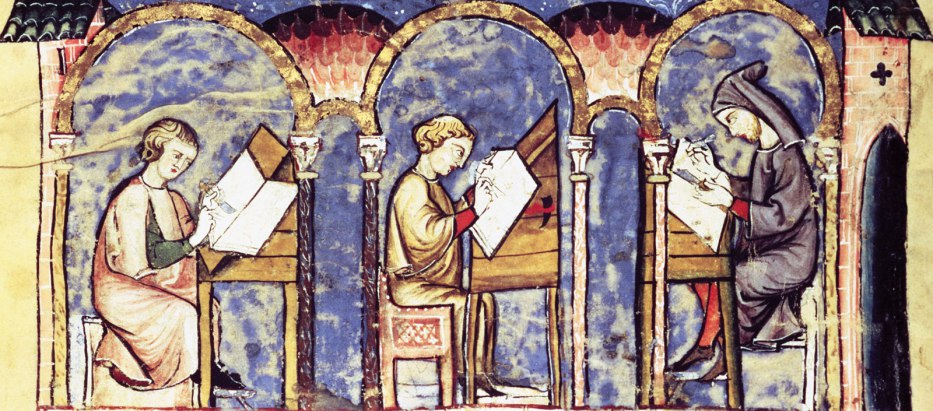
From Biblioteca de San Lorenzo de El Escorial, Madrid, Spain, c. 14th century AD

About a month ago during a conversation her (current) Highness of Oertha, Mistress Elena Verch Ryse suggested that I actually teach a class on how I do write-ups and documentation for my projects.  I thought about it (getting heavily distracted from my book as I essentially gave the lecture to myself), and decided that yes, this was something I could do and would schedule for West June Crown--a fairly major stepping point for me as I have thus avoided lecture style classes and stuck with more hands on ones where I didn't have to talk as much. 

The class went off with a small handful of brave souls--not as many as I would have liked, although there were two other classes going on at the same time, as well as something called "dinner".  As though a meal is needed after grazing all day... Still, it was a good class and we mostly stayed on topic, with a bit of perusing my library after. These are the class notes with everything I remember discussing; while my outline has been published before on this blog, I didn't discuss my theories in depth at all.  This particular class does not focus primarily on writing for competitions as most articles on the topic seam to, but more for writing to document it for your own personal gratification and to educate those who come after.

Friday, February 16, 2018

Plainsewing in Depth

Being the Class Notes/Synopsis of my class taught at St. Boniface Collegium (UAF) last November.

This class was intended to go over each of the sixteen or so different stitches I could think of, what uses they are most suited for, and how to choose your thread and wax...I didn't quite manage to get that all into the actual class since we kept running off on tangents. I had also anticipated more beginners in the class, rather than leading a class mostly containing experienced seamstresses. The goal of the class—and even more with this article--is to pass on some of the tips and tricks I've gleaned over the last few years of doing a fair amount of handsewing; both in SCA (Society for Creative Anachronism…pre-1603) and more modern sewing and tailoring, and to help make things easier for other historical costumers who want to do more in the way of handsewing. By no means is this article exhaustive and as I think of or learn more stitches, I will update.  Originally, I also intended to provide documentation for each stitch for each period (if it was used); I eventually decided to not do so because it turned out to be a lot more difficult and a more of a massive undertaking than I anticipated and I wanted to actually get the article published someday soon.


Supplies:

To start with, I will cover the required three tools and materials for handsewing and one optional one--this list does not include the fabric. Needle, thread, wax, and I highly recommend a thimble (semi-optional).

As you can see, I store my needles in an old Belgian Ale cork.
The jewelry pliers are helpful for sewing through many layers
and when your fingers start slipping.

Monday, December 19, 2016

(SCA) Period Buttonholes, the Class Handout

Buttonhole construction for All; Medieval and Elizabethan Buttonholes 

Photograph by Halfdan "Twobears" Ozurson of the Buttonhole class at Selviergard Yule.
Essentially, the way it works is that the construction and form of buttonholes has changed a fair amount since they show up in the early 1300s. Happily, the changes are actually linear for once—you can easily see the evolution from the original, fairly rough examples, to the modern keyhole buttonhole. However, since this is an SCA class, I will only cover the evolution through around 1600.  The full article can be found as my Buttonholes Through the Periods.

They can basically be broken down into two parts, as you might guess; Medieval, and Elizabethan. I could probably add Late Medieval/Early Renaissance (1400s) in there as well, but since it is firmly between the other two in style and construction, I doubt I need to. Both styles are worked with a buttonhole stitch—not ever a blanket stitch--, which you hopefully know how to do; if not, you’ll learn.  All period buttonholes are worked perpendicular to the edge of the material, and fairly close to the edge.

Saturday, March 21, 2015

Drafting Patterns from Extant Garments


Ever wondered how to take those line drawings of an extant garment—like those Medieval Garments Reconstructed, Marc Carlson’s database, or Patterns of Fashion--, and make it fit you, while remaining as true to the original garment as possible? Or better, photographs of the garment itself and figure what shape the pieces are?  
            This is the method I used for most of my major projects; The Sture Suit, G63, and most notably my Moselund Kirtle, as well as a number of projects which are planned but not constructed.

            A point on terminology for reconstructing garments (this is what I use): A museum replica is a piece made entirely with the correct technology, to be as close to identical to the extant piece when new (as possibly).  A working replica (what this class is geared towards making) is patterned from, and maintains the proportions of the extant as much as possible while having it fit you, as well as construction and definition; however, the fabric might not be spun/woven to order.  "Inspired by" I do not consider to be reconstructing a garment--you may be making a perfectly good, period piece, but the goal isn't to get as close to a specific extant garment as possible.