Showing posts with label 16th Century. Show all posts

Monday, July 1, 2024

A Common Man's Doublet

©Travis Abe-Thomas, June 2024

Finally!  I actually finished another project, and in time to debut the suit at the second ever West Kingdom Crown hosted by Oertha.  This is the white hemp canvas doublet I have been plugging away at for the last two years, to be paired with the black wool round hose as a "working" suit which would age and develop what we're going to call "character"...also known as stains and hopefully wear patterns.

When designing the project, I knew I wanted a fairly simple outfit from the end of Elizabeth's reign--round hose, and a fairly plain doublet.  As working class people aren't the most popular subject for art (unless accompanied by quaint villages and beautiful scenery as in my Low Countries Research), I eventually found what I was looking for in Samuel Pepys's Cries of London.  

Sunday, June 9, 2024

Peasant Fashion in the Low Countries: Stage 2; Frans Boels

Frans Boels, B. 1555 - 1596, most of his paintings are of the landscape variety, often with Biblical scenes.  He was trained by Hans Bol, his stepfather.  As such, only a handful are of use for this project.  However, as the paintings are accurately dated for the most part, they are particularly useful as they likely show /current/ fashion in the peasant class for the 1590s, unlike the more romanticized versions by the Brueghels for instance. 

Monday, February 12, 2024

Peasant Fashion in the Low Countries: Part Two. Pieter Bruegel the Elder

Pieter Bruegel the Elder.  One of the first artists who come to mind when you think of this genre of painting, and the one this project was named for.  He was born between 1525 and 1530 near Breda and died in 1569, after living primarily in Antwerp then Brussels.  His early work is mostly in engraving and drawings, with the majority of his well known paintings came after 1555.


  • Parable of the Sower.  1557.  https://www.wikiart.org/en/pieter-bruegel-the-elder/parable-of-the-sower-1557 
    • Only guy
      • Hat is black and mostly shapeless, although there does appear to be some kind of brim.
      • Outer garment is grey and only hip length.  Sleeves are rather poofy, with a separate closer fitting pieces at the forearm.  In the left (as worn) sleeve, you can see a slit.  The garment may be lined in red, and may have a crossover front.  
      • Doublet, not really visible, except as more grey.
      • Hosen are of the knee length breeches style in a lighter shade of grey.   No details are visible as to whether there is a codpiece or not.
      • Netherstocks are a grey inbetween the breeches and jerkin in colour.  You can see slight bagging at the ankle.
      • Shoes are low, and slip on, but do enclose the foot completely.  Leather is black.
      • He is clean shaven, and short haired...and appears to be black.  There may be sideburns going on, but I am not sure.

Saturday, July 22, 2023

A Procrastinated Pair of Round Hose

    Some years ago, in the Pre-Covid times, I decided I wanted to make a plain suit of Elizabethans.  Something from the very end of Elizabeth's reign, and suitable for working in; setting up tents, fighting, maybe some hiking, sitting in the tavern, etc.  A suit of late period clothing where getting it dirty would only add to the character of the garments rather than spoiling them.  In the end, I settled on a suit of round hose in wool broadcloth, and a doublet in another broadcloth or hemp/linen canvas.  While the doublet is still in the works (but is actually being worked on!), I actually finished the round hose over a year ago; I just haven't had any motivation to write (acquiring a new, functional computer helped a bit, but that was purchased *mumble* months ago...).  Wish me luck on this...I'm well out of practice on writing at all, never mind project documentation; thankfully, I took a fair amount of notes...but not enough.

    The hose are, as said, made in common man's cloths and suitable for the tail end of the 1500s and into the 1600s..  Finding exemplars was more difficult than the norm for this period, as working class people aren't particularly popular subjects of paintings, and I additionally had a particular look in my head.  In the end, the Samuel Pepys's Cries of London was a major resource and inspiration for both the hose and doublet forms.

    The Cries of London is a particular genre of artwork which often dealt with the lower classes of various cities (e.g London, Bologna).  The term allegedly comes from the "Cries" or calls of the various traders as they tried to attract customers [Payne, abstract].  In the case of the examples collected by Samuel Pepys, the collection we know as gathered up to 100 years after publishing.  The actual artist of these is unknown, as is the original date, although based on fashion style I estimate this example is from last quarter of the 16th century.

From Spitalfields Life Blog

Tuesday, January 28, 2020

A Wild Irish(wo)man's Inar

A couple of months ago, my Donna and Pelican was asked to join the Order of Defense, the peerage for fencers in the SCA.

As she had nothing nice to wear for her elevation about 6 weeks later at Winter Coronet, we discussed options, and settled on 16th Century Irish (her Persona and mine) menswear--partly so she could borrow pieces from my wardrobe, and partly because the main outer layer really doesn't require much fabric.  So...I set to procrastinating.  For the better part of a month.  Not a big issue...even with handsewing an inar doesn't take much time, since there really aren't a lot of seams.

Photo by Twobears Photography
However, since it was for a special occasion I wanted the garment to be bling, and elected to try to keep my doing so a secret except from select support crew who were sewn to secrecy. 

Wednesday, October 16, 2019

Leather Party Pluderhose: The Documentation

The party pluderhose is a project I had been thinking about for some time--I wanted a pair of pluderhose which were a bit more durable, and which I actually handsewed (the Brunswick suit was machine sewn, if with a considerable amount of handwork).

Once again, I have a love/hate relationship with this garment--they are so extra that I love them, along with the challenge of drafting them.  On the other hand, they have a lot of material in them so are not particularly lightweight to wear, and do require the wearing of stockings.  Also, while period codpieces only had two points holding them up, because I make most of my late period gear for SCA fencing, it needs to be more secure than that--and tying those fiddly little points with cold hands is a nuisance.

This is the full documentation, which covers just about every step of my design, construction, and decisions.  If you just want to look at the photo shoot and read an overview, click here for my previous post. 

Tuesday, September 10, 2019

I knitted a...a...

...Well, I scalped a muppet.  And it was glorious...the prickly thing put up a fight, but in the end I was triumphant!

The one I made for myself, on it's debut expedition for mushrooms.
About a year or so ago I picked up knitting as something to work on during down time at my day job.  I started with a couple of scarfs--the first 4th Doctor inspired Ravenpuff scarf taking all winter, then went on to a couple of hats.  Specifically, a thrum hat.

Thursday, August 29, 2019

A Work-a-Day Elizabethan Shirt

Well...mostly work a day.  This project was intended to be just a shirt to wear under my late period wear; one which does /not/ have silk insertion seams as the last shirt I made does.  Even though the silk sewn shirt is fairly heavy and should be durable, my brain won't let me abuse and get it dirty as I probably will with this one.   This project was completed a good six months ago, and took about nine months of procrastinating to finish--there is a certain amount of guesswork since I wasn't doing a good job of journaling my projects during that time.

Wearing the pluderhose from my Brunswick Suit for the photos.

Tuesday, August 6, 2019

Party Pluderhose (and Chocolate doublet): The Overview and Photoshoot

About fifteen months or sew ago, I decided I really wanted to make a pair of leather pluderhose.  Something exaggerated, slightly shocking, but subdued in colours.  Something which would be relatively comfortable, and suitable for both rapier combat, as well as the bardic and partying afterward. And for court, I suppose.

This is what I came up with.

Wednesday, November 28, 2018

Peasant Fashion in the Low Countries: Stage Two. Hieronymus Bosch

Yes, that Hieronymus Bosch.  Most of his work is not of any kind of use for this project, but two paintings are noted down as not being suspect, one noted as a "maybe", and three which are suspect, but may still be of use.  So, thankfully, this should be a relatively short post.

Bosch was born 1450 and died 1516....rather earlier than most of the works in this survey.  He grew up and lived in the s-Hertogenbosch, in the Dutchy of Brabant (Southern Netherlands).  He moved to Oirschot around 1480--the region a bit south of his birthtown, by about 11 minutes (Latitude).


 Because of Bosch's allegorical style of paint, and his active dates, the majority of his works are outside the subject of this survey, so I will only be covering a few.  Again, I am covering only the clothing of male and peasant class.


Monday, May 7, 2018

Peasant Fashion in the Low Countries: Stage One

Some time ago--in response to having been recently working on a garment which was for high court--I decided I wanted to play with Low Countries clothing.  Specifically, peasant clothing.  Fashion A La Brueghel, as I immediately dubbed it.  Historical Dutch beer may have also been involved in this decision, because who doesn't design an outfit to match a beer they might be drinking?

That is where I ran into a snag.  While there are several excellent articles out there on /women's/ Low Countries clothing, the selection of articles covering the details for menswear was decidedly lacking.  So, naturally, I decided I needed to do a bunch of research and write my own articles on the topic.  I fairly quickly decided on the plan of going through the artwork of Brueghel and other Flemish artists of the period, and winnowing out any pieces which did not have usable details; so marking down any paintings which had the distinctive clothing of the correct class (i.e. Not Nobility), and which weren't purely allegorical and religious in tone since the clothing of those is often suspect.

Tuesday, April 3, 2018

Bad Penny Pluderhose: Drafting the Foundation Shorts (Again)

A couple of years ago, I made my last pair of pluderhose and wrote up a tutorial on drafting them throughout the various stages.  When I revisited them with the plan to make another pair this year, I found that my most excellent instructions...didn't work.  Partly because I didn't take one of my measurements correctly, but my old instructions are also clunky.  Especially in the section regarding some rather esoteric and personal measurements.

The garment itself is somewhat complicated, and I am sure has been the cause of many grey hairs in re-enactors--partially because there are no patterns or instructions for them online.  Well...there is one, but it is not remotely period as it seems to be based on modern pajama pants).  Reconstructing History also sells a pattern, which I have no experience with, and no desire to--I don't need help going mad.  So, when I went to draft out a new pluderhose foundation pattern, and found that my old instructions had issues, I realized I would have to mostly rewrite it.  As before, this pattern is based on the pairs worn by Nils and Erik Sture (mostly Nils, because I believe Erik's pair of foundation breeches got stretched with wear).

This tutorial series for the pluderhose consists of four parts; the base breeches/foundation shorts; panes and lining; codpiece; and assembly.  In the example pairs, the foundation breeches were made of a fine leather, similar to chamois or a soft deerskin--previously I used a heavy cotton (cotton drill), this time I have deerskin splits to use (which should be attributed to my madness, because it will be a pain.  Spend the extra money, and don't use splits if you decide on leather, since they are uneven in thickness).  Depending on the particular style, the foundation breeches can be around knee length (and sewn to the legband at the bottom) as in Nils', or free at the bottom and a bit shorter as I believe Erik's was.

Foundation shorts of Nils Sture's pluderhose, 1568. 
Patterns of Fashion 3, by Janet Arnold

Saturday, December 30, 2017

HSM 2018...plots and thoughts

It almost didn't happen--but the denizens of the Facebook group prodded us (the Moderators) until the ball got rolling...then it kinda happened by itself, and we just had to organize.  And finalize descriptions, which was actually kinda tricky.  But we did it, and so there will be another year...and hopefully many more, so long as participants remain excited.

http://thedreamstress.com/the-historical-sew-monthly-2018/


Enough of that...  For my few readers who are not familiar with it, the Historical Sew Monthly is a series of sewing challenges or prompts for Historical Costuming, which you have to finish (NOT start) within two months of the deadline.  You can participate in many, or only manage a couple!  For more information, go to the Dreamstress' overview/sign up page. 

Wednesday, July 12, 2017

The Nauseatingly Stripy Trunkhose


This project is a pair of trunkhose, similar in style to those of the late 1560s, made of the same fabric and to wear with the same doublet as in the Brunswick suit.  The design is fairly general, not based on any one particular example, but is closest to one in the French rapier manual by Sainct Didier.  Because this particular project was intended more as a trial run, I am not worrying about documenting everything.


Thursday, June 8, 2017

Whose sleives hang trailing down Almost unto the shoe: the 16th Century Irish Leine


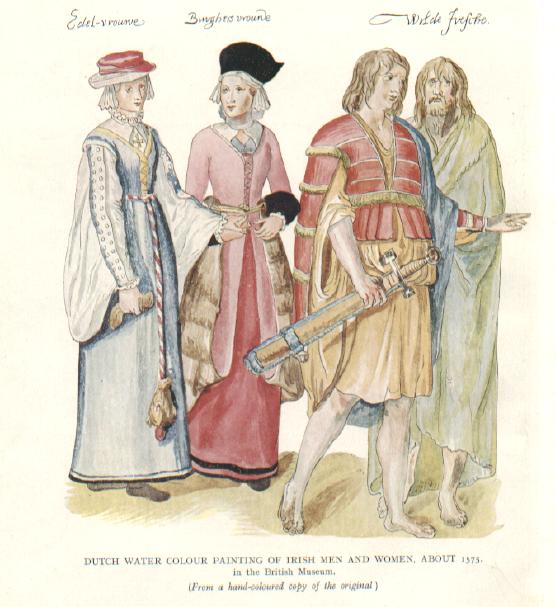
This project has been a long time coming; many (relatively) years ago, I wrote an article on 16th century clothing---my first serious research article, in fact.  It is only now that I have actually gotten around to making a suit of Wild Irish clothing, consisting of the leine and inar, as well as the shaggy brat.


The Project: 
This piece of documentation discusses bottom layer of the 16th century project….the leine.

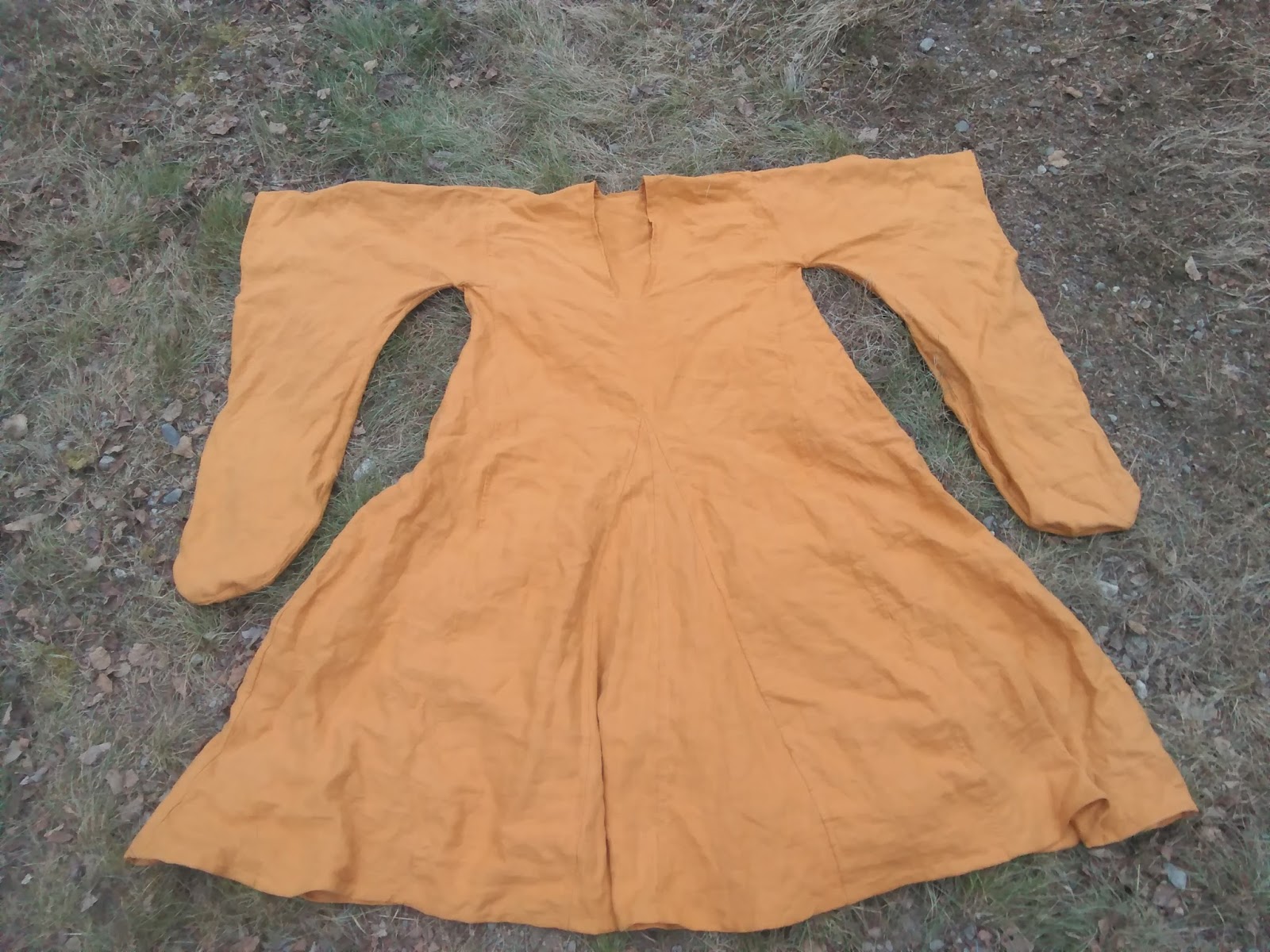
The leine--a word translating now as shirt--appears essentially as a linen tunic, almost universally "saffron yellow", although lady's versions do appear in white, and I suspect that the lower classes might make due with natural coloured linen (ranging in colour from blue-grey to a lighter yellow[i]--I will discuss this more later).  For both sexes, pendulous or bagpipe style sleeves were the norm, as was the use of massive quantities of linen cloth.  Men, at least, wore theirs bloused over a belt, to bring the garment to knee length.

Tuesday, March 28, 2017

Plotting the Next Major Project...another 1570s Suit

So, shortly after being asked to join the Laurels in the SCA a touch over two months ago at Oerthan Winter Coronet* I decided that I needed to attempt a real masterwork project for my elevation.  My last major project, the Brunswick Germans was decent...a good trial run of techniques and getting me closer to my goal of a tailored period court suit, but not an attempted masterwork--if not the use of machine stitching, the choices of non-period fabrics was a bar to that in my mind.  But now, I can actually afford the good fabrics to do it right, rather than working primarily from stash.

So, I decided to poke around, and see what I could find for inspiration.  This was somewhat complicated by wanting to find something I could/would actually wear, but other than the Germans I have been playing with.  Eventually, I ran across a certain portrait--one Sir Edward Hastings at the age of 29, in 1573.  It is absolutely gorgeous, and I will probably do a Featured Garment post on it sooner rather than later.

ART UK 597951

Tuesday, March 14, 2017

The Other Next Project; Wild Irish

I'm also starting another project this week--just waiting on thread.  I've been planning it for quite a while...even bought the fabric almost a year ago.


 And that is: 16th Century Wild Irish.  I figured it is time, especially since I wrote the article on 16th century Irish clothing more than a few years ago.  The outfit is really quite simple; the basis is the leine of golden yellow linen, the inar of red wool, and that is essentially all.  A fringed woolen brat is also a requirement, but I made mine a good 4.5 years ago (and use it every day).  No shoes, pants, or hat required.

Wednesday, January 25, 2017

The Final Piece...the Tall Hat

This is it...the last piece for my 1570s Germans suit.  And boy, am I happy it's finally done.  The hat itself was a fairly quick and simple project....but I have been working on the overall project for just under a year now.  Because it is the last piece (yay!) I was able to enter it into the first Historical Sew Monthly challenge of 2017--Firsts and Lasts.

The Project:

This is an extremely tall, woolen hat, similar in profile to several examples from the period of 1570s Germany, which is part of my full suit from the same period (well, of course).  Unlike quite a few later examples, and my last tall hat, the covering is not a gathered circle, but fits smoothly over the base.

Thursday, November 3, 2016

1570s Germans Continued: The Jerkin

This has been a rather long journey, and it is finally nearing its end with the completion of this project--a slashed jerkin as part of my 1570s Germans suit.  The suit consists of pluderhose, doublet, jerkin, and hat, all drafted from my own patterns.  Like the other garments in the set...you don't get to see it being worn until the debut (probably in January).  Because the two garments are so closely related in pattern and design, I highly recommend reading my documentation for the doublet first. 

Sources:

The sources for construction and the primary inspiration are essentially the same as those for the doublet; with a few changes to show slashed jerkins.