
Monday, January 9, 2017
Aaand I present the 1750s Banyan Documentation. ...Finally.
This has been coming for a while, but I needed to finish (...or write, period) the third post on making the blasted thing. But here it is...the documentation for my 1760s banyan, which I shoehorned into the HSM Red challenge (yes, the garment is blue...but there is apparently enough red on it to count).


Tuesday, December 20, 2016
HSM 2017! It's happening again! The plots thicken...
As you may have guessed by the title, the Historical Sew Monthly is happening again, and this is my second year helping run it--I'm quite looking forwards to it, although some of the challenges are giving me trouble.
 For those who do not know, the challenge is to make or finish a historical (up until 1939) piece of clothing (or accessory) by the last day of that month, and is meant to support and encourage period methods. The piece can be finished up to two months before that--meaning the January challenge could be finished as early as December. The link to how it works can be found HERE, at the Dreamstress' page.

Monday, December 19, 2016
(SCA) Period Buttonholes, the Class Handout
Buttonhole construction for All; Medieval and Elizabethan Buttonholes
 |
| Photograph by Halfdan "Twobears" Ozurson of the Buttonhole class at Selviergard Yule. |
Monday, December 12, 2016
Continuing on: Putting the Banyan together
I suppose I should go over how the 1760s banyan goes together, shouldn't I? All in all, it's fairly straightforwarded...however, I found that there are a couple of counter-intuitive details in sewing the lining into place. I based the order of construction, and these little details on an excellent thesis on 18th century Waistcoats (in bibliography), which I figured are closer in construction that a full coat (assuming there are major differences). Other details are from discussing an extant frock coat with someone who had it to hand.


Thursday, November 3, 2016
1570s Germans Continued: The Jerkin
This has been a rather long journey, and it is finally nearing its end with the completion of this project--a slashed jerkin as part of my 1570s Germans suit. The suit consists of pluderhose, doublet, jerkin, and hat, all drafted from my own patterns. Like the other garments in the set...you don't get to see it being worn until the debut (probably in January). Because the two garments are so closely related in pattern and design, I highly recommend reading my documentation for the doublet first.


Sources:
The sources for construction and the primary inspiration are essentially the same as those for the doublet; with a few changes to show slashed jerkins.Thursday, October 20, 2016
A Robe for Reading: 1760s Banyan. I suppose I need sleeves, don't I?
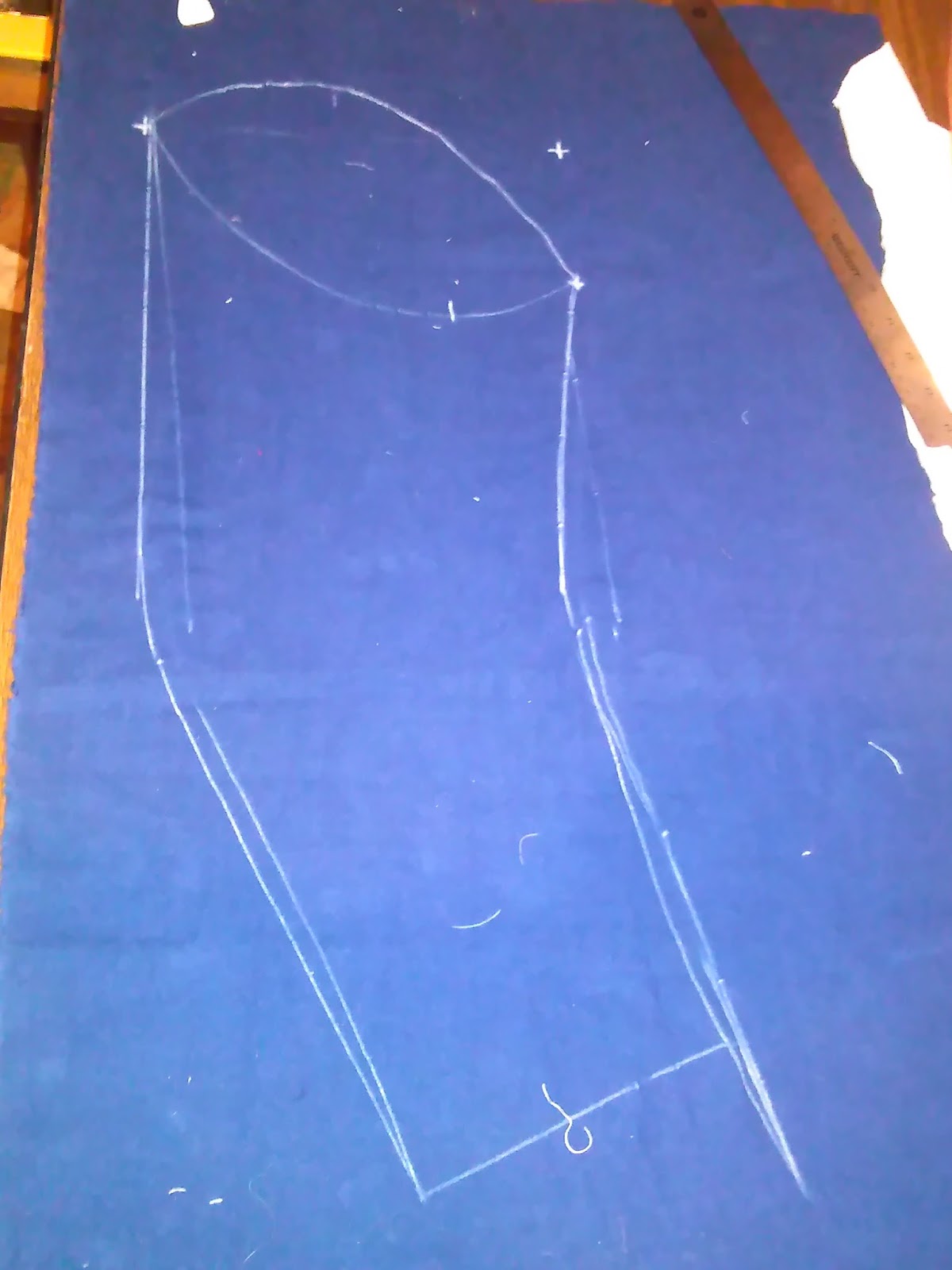
And it's time for Part Two of Three on the making of my Banyan, based on an example from the 1760s in the Los Angeles County Museum of Art. As you might guess by the title, the majority of this post is on drafting the sleeves--the cuffs and collar are both quite simple.
For a recap, this particular garment is based on the one the LACMA provided a lovely pattern and information on. However, while they provided a pattern, they do not tell you how to draft the garment so it fits you (their scaling grid is also terrible).
 The way I do sleeves is fairly simple; essentially you take the measurements of the armscye, and transfer those to your sleevehead. However, a word of warning that some parts of sleeve drafting--the hang of the arm in particular--are rather complicated, and something you will have to learn on your own (until I get good enough that I can explain it); when it comes to the lateral rotation (as swinging your arms normally) you want the top and bottom of the sleevehead to be in line with the natural hang of your arm. As such, it may not hurt to mark the low point while the body is on your victim as well.
For a recap, this particular garment is based on the one the LACMA provided a lovely pattern and information on. However, while they provided a pattern, they do not tell you how to draft the garment so it fits you (their scaling grid is also terrible).
Tuesday, October 4, 2016
Featured Garment: Bottle Green Overcoat (1820s?)
And I'm jumping back to the Regency, to share an elegantly plain overcoat or redinote. This Featured Garment will likely be fairly short.
 The victim of my mangled descriptions this time is a wool overcoat from Augusta Auctions, in the style of early frock coats...i.e. a body coat with a waist seam. As it should be, with the given date of the 1820s. It caught my attention because of the elongated look, and how low the buttons go (which is slightly unusual). The following is the description from the Auction Site:
Subscribe to:
Posts (Atom)