
Wednesday, January 25, 2017
1570s Brunswick Man: The Overview of a Year's Journey
So...this is it. The final post on the projects I've been working on for the last year--the 1570s Germans. It has been a long journey, full of working on new and old skills, and on my writing skills--a full ten posts have been published to cover the various steps, not including this one and the unpublished doublet drafting system. In addition, each item was entered in a Historical Sew Monthly challenge over the course of the year.


The Final Piece...the Tall Hat
This is it...the last piece for my 1570s Germans suit. And boy, am I happy it's finally done. The hat itself was a fairly quick and simple project....but I have been working on the overall project for just under a year now. Because it is the last piece (yay!) I was able to enter it into the first Historical Sew Monthly challenge of 2017--Firsts and Lasts.


The Project:
This is an extremely tall, woolen hat, similar in profile to several examples from the period of 1570s Germany, which is part of my full suit from the same period (well, of course). Unlike quite a few later examples, and my last tall hat, the covering is not a gathered circle, but fits smoothly over the base.Monday, January 16, 2017
HSM Special Occasion: A set of ruffs...almost...there!
As the title says, I'm almost there. Almost done with the year long project of making a 1570s German suit--all that remains is the hat.
 |
| Christ Blessing, Surrounded by a Donor Family. German Triptych. 1570s Note the untidy ruff. |
Sunday, January 15, 2017
Bi-annual Sewing Review: July-January 2016
Not just sewing, either--I will probably touch on some of my favourite articles I've written and posted here as well. My review for the first half of the year can be found HERE. Still, I want to touch on a couple of my major projects from before July as well.
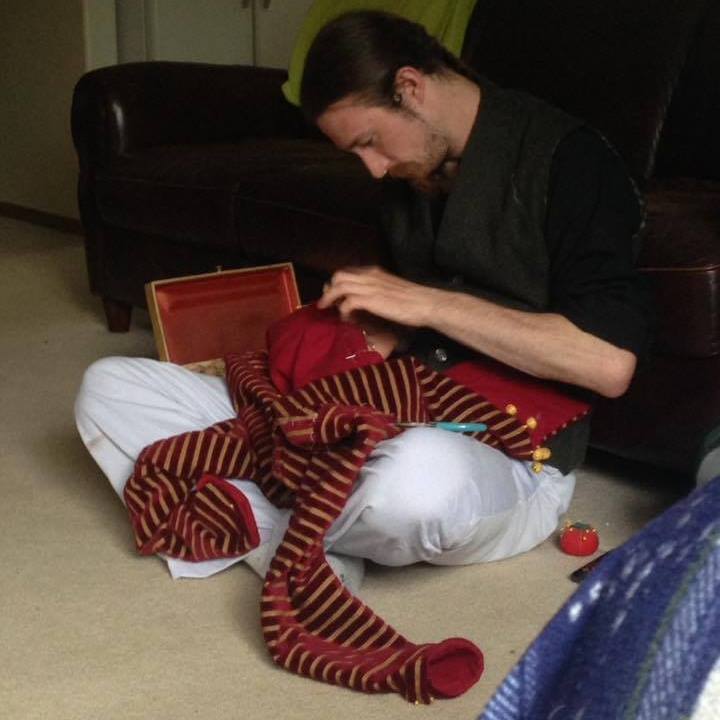 |
| Wearing all handmade clothing (wool shirt, wool waistcoat, and the front fall trousers), and working on the doublet. Photo by Mercedes Houlton. |
Monday, January 9, 2017
Aaand I present the 1750s Banyan Documentation. ...Finally.
This has been coming for a while, but I needed to finish (...or write, period) the third post on making the blasted thing. But here it is...the documentation for my 1760s banyan, which I shoehorned into the HSM Red challenge (yes, the garment is blue...but there is apparently enough red on it to count).


Tuesday, December 20, 2016
HSM 2017! It's happening again! The plots thicken...
As you may have guessed by the title, the Historical Sew Monthly is happening again, and this is my second year helping run it--I'm quite looking forwards to it, although some of the challenges are giving me trouble.
 For those who do not know, the challenge is to make or finish a historical (up until 1939) piece of clothing (or accessory) by the last day of that month, and is meant to support and encourage period methods. The piece can be finished up to two months before that--meaning the January challenge could be finished as early as December. The link to how it works can be found HERE, at the Dreamstress' page.

Monday, December 19, 2016
(SCA) Period Buttonholes, the Class Handout
Buttonhole construction for All; Medieval and Elizabethan Buttonholes
 |
| Photograph by Halfdan "Twobears" Ozurson of the Buttonhole class at Selviergard Yule. |
Subscribe to:
Posts (Atom)